How to Measure the Success of Generative Engine Optimization Campaigns
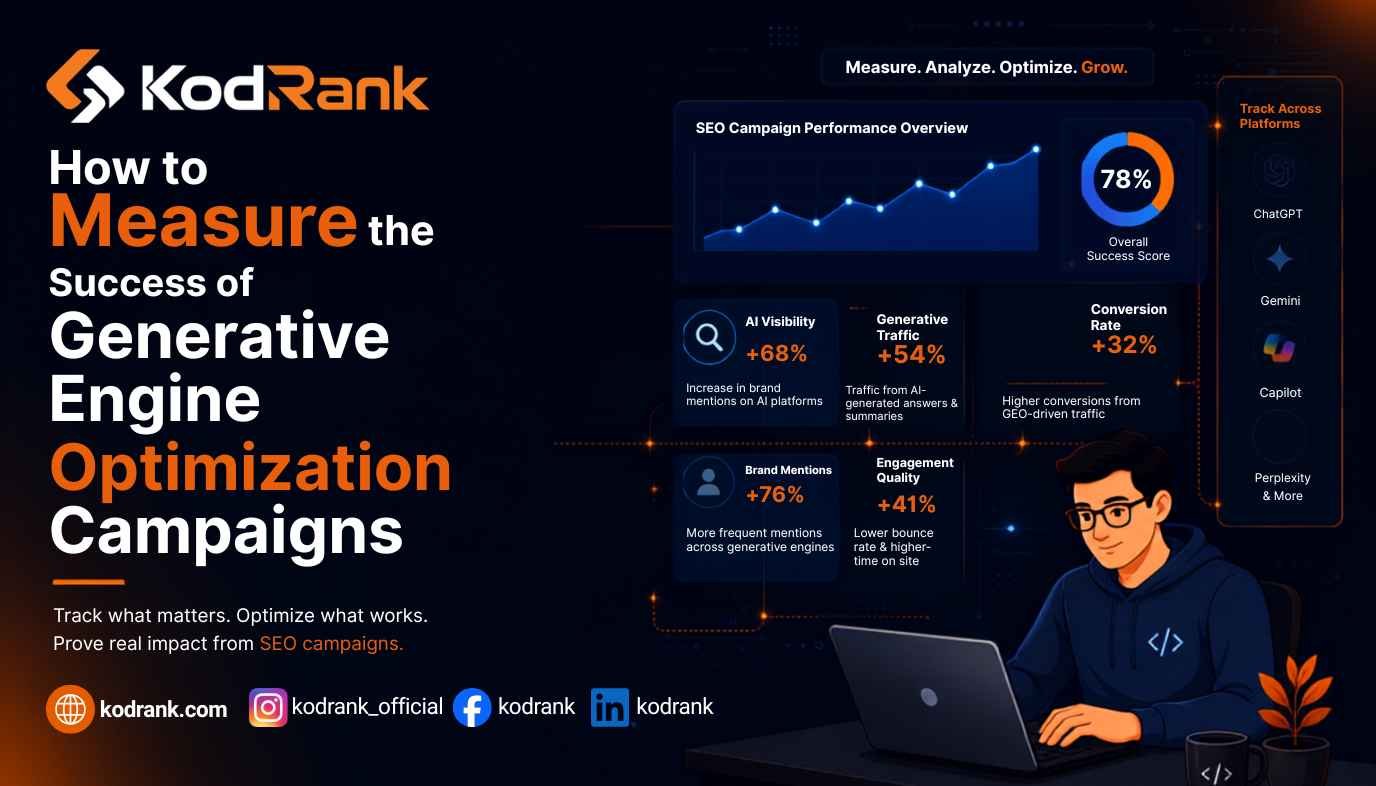
To measure the success of generative engine optimization campaigns, track five connected signals together: citation share (how often AI engines cite you versus competitors), prompt coverage (the share of your target questions where you appear), position and sentiment (how early and how favorably you're mentioned), AI referral traffic, and downstream business impact like leads and revenue. No single number tells the whole story — GEO success is a combination of signals that reveal whether AI systems can find, trust, and cite your brand.
That's the fundamental shift. Traditional SEO measures whether a page ranks in an ordered list. Generative engines work differently: they retrieve documents, extract facts, judge trustworthiness, and synthesize a single answer. A page can rank first on Google and never appear in a ChatGPT answer. So learning how to measure the success of generative engine optimization campaigns means building a repeatable method rooted in how AI engines actually choose what to cite — not repurposing old dashboards.
Why Measuring GEO Is Different From SEO
Classic metrics like click-through rate are no longer enough on their own. AI engines answer users directly and often don't send a click at all — AI summaries have been shown to reduce click-through rates by up to 34.5%, and Gartner projects traditional search volume will fall 25% by 2026. Yet those clickless answers still shape which brands buyers consider and shortlist.
This creates a measurement gap. Your existing rankings-to-clicks-to-conversions funnel can badly under-report GEO impact even when your brand shows up prominently in AI answers. A page with declining impressions but rising AI citations isn't failing — it's gaining ground in the emerging search layer while the legacy layer shrinks. Measuring GEO well means capturing that new layer directly instead of inferring it from old proxies.
The scale is why it matters: Google's AI Overviews already reach roughly 1.5–2 billion monthly users and appear in about half of all searches, and BrightEdge estimates that more than 60% of online searches will involve some AI-driven element by 2026.
The Three Tiers of GEO Measurement
The cleanest way to think about GEO metrics is in three layers, each answering a different question.
Tier 1: Infrastructure Metrics (Are You Ready to Be Cited?)
These measure whether AI systems can even access and understand your content — crawlability by AI bots, structured data coverage, semantic clarity, and content freshness. They're leading indicators: weak infrastructure caps everything downstream, so they're where you look first when citations aren't happening.
Tier 2: Visibility Metrics (Is Citation Actually Happening?)
These are the outcome measures that tell you whether AI engines are citing you. This is the heart of GEO reporting and where most of your attention should go.
Tier 3: Business Impact Metrics (Is It Driving Value?)
The ultimate goal of GEO is revenue and conversions, not vanity citations. This tier ties AI visibility to referral traffic, leads, pipeline, and ROI — the numbers that earn budget and trust from leadership.
The Core GEO KPIs Worth Tracking
None of these stands alone. Together they tell the real story of how to measure the success of generative engine optimization campaigns.
1. Citation Share (Share of Voice)
This tracks how often you're cited versus competitors for your target prompts. It's the closest thing GEO has to a ranking, and a rising share is the clearest sign you're winning. Keep the signal clean by choosing five to ten priority prompts and watching your share on those first — trying to track everything at once only buries what matters.
2. Prompt Coverage (AI Visibility Rate)
Coverage measures the share of your target prompt set where your brand appears. The math is simple: if you test 50 important prompts and appear in 15 answers, your AI visibility rate is 30%. If a competitor appears in 30, theirs is 60% — an immediate, honest benchmark of where you stand.
3. Citation Frequency / Mention Rate
How often your brand, products, or pages appear in synthesized answers across ChatGPT, Claude, Gemini, Perplexity, and Google AI Overviews. Where citation share is relative to competitors, mention rate is your absolute presence across the ecosystem.
4. Position / Prominence Score
Not all mentions are equal. This captures how early and how prominently your brand appears in an answer — being named in the first sentence carries far more weight than a passing reference at the end.
5. Brand Sentiment in AI Answers
A qualitative but critical KPI: the tone AI uses when it mentions you — positive, neutral, or negative. Because these answers shape buyer perception directly, sentiment can matter as much as frequency for your brand image.
6. Attribution Quality
Whether the AI credits you with a direct link, a named mention, or nothing traceable at all. Higher attribution quality means more discoverability and more measurable referral value.
7. AI Referral Traffic and Downstream Impact
Filter your analytics for AI user agents and referrers to see traffic arriving from AI platforms — then connect it to leads, pipeline, and revenue. Remember that much GEO value is delayed and clickless: a buyer may see you in an AI answer, then arrive later via branded search, direct visit, or a sales referral, so avoid judging GEO on last-click attribution alone.
A Step-by-Step Method to Measure GEO Success
You don't need an expensive platform to begin. Build the habit first:
- Define 5–10 priority prompts that reflect how real buyers ask about your category, including commercial queries like "best [tool] for [use case]."
- Test those prompts across engines — ChatGPT, Perplexity, Gemini, Claude, and Google AI Overviews — and log whether and how you appear.
- Record citation share, position, and sentiment for each result in a simple tracker.
- Benchmark competitors on the same prompts to see who's gaining and who's slipping.
- Tag AI referral traffic in analytics and tie it to conversions and pipeline.
- Re-test on a fixed cadence (weekly or biweekly) so you can see trend lines, not one-off snapshots.
Get this method right and the missing dashboard stops being a problem — the discipline matters more than the tool.
Tools That Automate GEO Measurement
Once manual tracking starts costing real hours each week, a dedicated platform pays off by automating prompt testing, citation logging, and competitor tracking across engines. In 2026 the measurement gap has narrowed sharply: platforms like Profound offer enterprise insight into how brands are framed within LLM responses, while SE Ranking provides a Brand Visibility Score tracking sentiment and share of voice across the AI ecosystem. The field ranges from affordable monitors to full enterprise suites — pick a tool only once manual tracking becomes a genuine time drain, and choose based on your scale.
Common GEO Measurement Mistakes to Avoid
- Relying on CTR and rankings alone — they miss the clickless AI layer entirely.
- Tracking too many prompts at once — start narrow so the signal stays clean.
- Judging GEO on last-click attribution — much of its value shows up later through branded and direct traffic.
- Ignoring sentiment and position — a negative or buried mention isn't the same win as a prominent, favorable one.
- Measuring once and stopping — GEO visibility fluctuates, so trends matter more than snapshots.
Frequently Asked Questions
How do I measure the success of generative engine optimization campaigns? Track citation share, prompt coverage, mention frequency, position, sentiment, attribution quality, and AI referral traffic together, then connect them to leads and revenue. GEO success is a blend of signals, not a single metric.
What is the most important GEO metric? Citation share — how often AI engines cite you versus competitors for your priority prompts — is the closest equivalent to a ranking and the clearest sign your strategy is working.
Can I measure GEO without paid tools? Yes. Start by manually testing 5–10 priority prompts across ChatGPT, Perplexity, Gemini, and AI Overviews and logging your results. Add a dedicated platform only when manual tracking costs real time each week.
Why don't traditional SEO metrics work for GEO? Because AI engines answer users directly, often without a click. Metrics like CTR and rankings capture the legacy search layer but miss whether AI systems are citing and trusting your content.
How often should I measure GEO performance? Weekly or biweekly. AI answers change frequently, so consistent re-testing reveals trends and competitor shifts that a one-time check would miss.
The Bottom Line
Knowing how to measure the success of generative engine optimization campaigns comes down to combining the right signals: infrastructure readiness, real citation and visibility data, and the downstream revenue those citations drive. Pick a focused set of prompts, track citation share and sentiment over time, benchmark competitors, and connect it all to business outcomes. Do that consistently and you'll know — with evidence, not guesswork — whether your brand is winning the AI answer layer.
Want a GEO Program You Can Actually Measure?
Kodrank builds generative engine optimization campaigns designed around measurable outcomes — from citation share to pipeline. Explore our GEO services to get your brand cited in AI answers, and our AEO services to own the direct answers in featured snippets and AI Overviews.
Kodrank is ready to help your brand get cited — and prove it with real numbers. Talk to our team and let's build a GEO strategy with measurement baked in from day one.