What Is Adaptive Software Development? A Practical Guide
Adaptive software development (ASD) is an agile framework built on one honest admission: on complex projects, you won't get the plan right at the start. So instead of pretending you can, ASD swaps the classic plan-design-build sequence for a repeating cycle of speculate, collaborate, and learn.
If you've ever watched a carefully scoped project fall apart the moment real users touched it, you already understand the problem ASD was built to solve. Requirements shift. Markets move. The feature everyone fought for in the kickoff meeting turns out to be the one nobody clicks.
This guide explains what adaptive software development is, where it came from, how its three-phase lifecycle works in practice, how it compares to Waterfall and Scrum, and when it's the right fit for your team or product.
What Is Adaptive Software Development?
Adaptive software development (ASD) is an iterative, agile software development method that replaces fixed upfront planning with a repeating cycle of three overlapping phases: speculate, collaborate, and learn. It was developed by Jim Highsmith and Sam Bayer out of their work on rapid application development (RAD), and it treats constant change as the normal state of a project rather than a failure of planning.
In plain terms, ASD tells a team three things:
- Your plan is a hypothesis. Treat it as a best guess you expect to revise, not a contract you're bound to.
- Build in short, timeboxed cycles. Each cycle delivers working features that real people can react to.
- Learn deliberately. Every cycle ends with honest feedback that reshapes the next one.
The key mindset shift is from determinism ("if we plan carefully enough, we'll get it right") to emergence ("the right solution will take shape as we build, test, and learn"). That's why ASD is a natural fit for software where nobody, including the client, can fully specify the end product on day one.
Where Did Adaptive Software Development Come From?
ASD came out of the 1990s, when project managers Jim Highsmith and Sam Bayer were working on rapid application development projects. They noticed that the traditional Waterfall approach, which locks in requirements, then designs, then builds, kept breaking down on complex, fast-moving projects.
Their answer was to stop fighting uncertainty and start designing for it. Highsmith formalized the approach in his 2000 book, Adaptive Software Development: A Collaborative Approach to Managing Complex Systems (Dorset House).
A year later, in February 2001, Highsmith was one of the seventeen practitioners who met at the Snowbird ski resort in Utah and produced the Manifesto for Agile Software Development. He also wrote the official history of that meeting on behalf of the Agile Alliance.
That timing matters. ASD isn't a spin-off of Agile; it's one of the methods Agile grew from. If you read the Manifesto's preference for "responding to change over following a plan," you're reading an idea ASD had already put into practice.
The Adaptive Software Development Lifecycle: Speculate, Collaborate, Learn
The ASD lifecycle is a loop, not a line. Each pass through speculate, collaborate, and learn produces working features, and what the team learns at the end of one pass becomes the plan for the next. The lifecycle focuses on results rather than tasks, and those results are defined as application features.
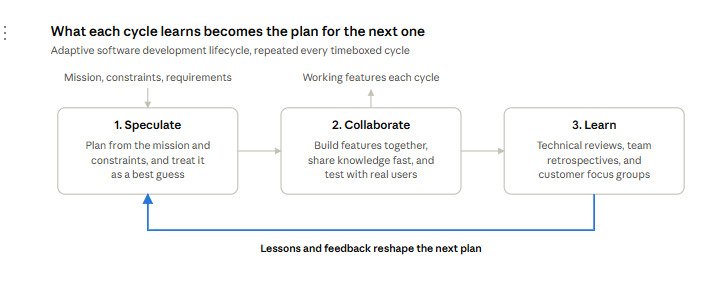
Each pass starts from the mission and constraints, produces working features, and ends with lessons that reshape the next plan.
To make each phase concrete, imagine a small team building an appointment-booking SaaS product for independent clinics.
1. Speculate: Plan Without Pretending
Highsmith deliberately replaced the word plan with speculate. The team still plans, but it openly accepts that some of its assumptions will be wrong.
During this phase, the team uses project initiation information, such as the customer's mission statement, constraints like delivery dates, and basic requirements, to define a set of release cycles (software increments).
Example: The clinic team's mission is "reduce missed appointments." Their speculative plan: cycle one delivers online booking and automated reminders, cycle two adds rescheduling, cycle three adds payments. Everyone knows this order may change.
2. Collaborate: Build Together, Share Knowledge Fast
Complex software needs more knowledge than any one person holds, so ASD leans heavily on teamwork. Developers, designers, testers, and client stakeholders share information continuously instead of passing documents down a chain.
Collaboration in ASD also depends on trust. Team members need to be able to criticize without hostility, help without resentment, and raise problems early, before they become expensive.
Example: Instead of waiting for a finished booking screen, the team puts a rough version in front of two clinic receptionists mid-cycle. Within a day they learn that receptionists book most appointments by phone, so the admin view matters more than the patient-facing one.
3. Learn: Turn Results Into the Next Plan
The learn phase is where ASD earns its name. After each iteration, the team reviews what it built and, more importantly, what it assumed. Common ASD learning practices include:
- Technical reviews to check code quality and architecture
- Project retrospectives to improve how the team works
- Customer focus groups to see how real users respond to the features
Short iterations are the point: the team learns from small mistakes instead of large ones.
Example: The focus group shows clinic owners care far more about reminder delivery than online payments. So the next speculative phase moves payments down the list and adds reminder customization. The plan changed because the evidence changed.
Why the Three Phases Overlap
In practice, the phases don't run in strict sequence. You can't speculate well without learning, and you can't learn without collaborating. A team is often building one feature, gathering feedback on another, and re-planning a third at the same time. Think of the three names as modes of thinking, not calendar stages.
6 Key Characteristics of Adaptive Software Development
An ASD lifecycle has six defining characteristics: it is mission-focused, feature-based, iterative, timeboxed, risk-driven, and change-tolerant. Here's what each one means on a real project.
|
Characteristic |
What it means |
What it looks like in practice |
|---|---|---|
|
Mission-focused |
A clear mission sets boundaries, even when detailed requirements are still fuzzy. |
When two features compete for the same cycle, the team picks the one that serves the mission better. |
|
Feature-based |
Progress is measured in working features customers can use, not in completed tasks. |
A status update says "patients can now reschedule online," not "database schema 80% done." |
|
Iterative |
Frequent releases generate feedback that sets the direction for the next round. |
Each cycle ends with something usable that stakeholders can test. |
|
Timeboxed |
Every cycle has a fixed length that forces hard trade-off decisions. |
When time runs short, scope shrinks; quality and the deadline stay put. |
|
Risk-driven |
Cycles are planned around the most critical risks first. |
The riskiest integration gets built and tested early, not saved for the final month. |
|
Change-tolerant |
Change is treated as a potential competitive advantage, not a problem. |
A new client request is assessed on its value, not rejected for being "out of scope." |
One nuance is worth calling out. In ASD, a timebox is not a whip for overtime. It's meant to focus the team and force decisions, not to push people into long hours or let quality slip. (Tutorialspoint)
The mission matters just as much. Without a clear mission that gets refined over time, iterative work tends to swing back and forth without making real progress.
Adaptive Software Development vs Waterfall vs Scrum
The short answer: Waterfall assumes you can predict the outcome, Scrum gives you a structured framework for adapting, and ASD gives you a mindset and lifecycle for adapting, with fewer prescribed rules.
|
|
Adaptive Software Development |
Waterfall |
Scrum |
|---|---|---|---|
|
Core belief |
Outcomes emerge through learning |
Outcomes can be planned upfront |
Progress comes from inspecting and adapting each sprint |
|
Lifecycle |
Repeating speculate, collaborate, learn cycles |
Linear: requirements, design, build, test, deploy |
Repeating sprints with planning, daily scrum, review, retrospective |
|
Planning |
Speculative and revised every cycle |
Detailed, fixed early |
Product backlog refined continuously |
|
Response to change |
Expected and welcomed |
Costly; handled via change requests |
Welcomed between sprints; the sprint goal stays protected |
|
Iteration length |
Short timeboxed cycles |
One long pass |
Fixed sprints of one month or less |
|
Team structure |
Lightweight; emphasizes collaboration over set roles |
Specialists hand off between phases |
Product Owner, Scrum Master, and Developers |
|
Best for |
High-uncertainty, innovative products |
Stable, well-understood requirements |
Teams wanting a clear, repeatable agile structure |
Scrum's structure comes from the Scrum Guide by Ken Schwaber and Jeff Sutherland. Its 2020 edition defines three accountabilities, five events, and three artifacts, with sprints fixed at one month or less.
Is Adaptive Software Development the Same as Agile?
Not exactly. Agile is the umbrella philosophy; ASD is one specific method under it. In fact, ASD came first. It's an antecedent of the agile movement, and its creator helped write the Agile Manifesto. Scrum, Extreme Programming (XP), Crystal, and ASD all share agile values, but each puts them into practice differently.
Many modern teams blend them. A common pattern is using Scrum's sprint mechanics while borrowing ASD's habit of treating every plan as a hypothesis to be tested.
Benefits and Limitations of Adaptive Software Development
ASD's biggest strength is that it reduces the risk of building the wrong product. Its biggest weakness is that it asks for a level of trust, involvement, and flexibility that not every client or organization is ready for.
Benefits
- It absorbs changing requirements. Requirements churn remains one of the most common reasons software projects go over budget. ASD expects change, so a new insight becomes input for the next cycle instead of a crisis.
- It catches wrong assumptions early. Because users see working features every cycle, a bad idea gets exposed in weeks, not after launch.
- It delivers value sooner. Stakeholders get usable features throughout the project rather than one big reveal at the end.
- It builds a stronger team. Constant collaboration and learning spread knowledge across the team, so you're not dependent on one person who "knows how it all works."
- It keeps the client close. Regular reviews mean there are far fewer surprises on launch day.
Limitations
- Fixed-price quotes are harder. If the plan is speculative, a precise upfront cost and timeline are too. That can make budget holders uneasy.
- It depends on experienced people. ASD gives teams freedom, and freedom works best with developers who have strong judgment, not just technical skill.
- The client has to show up. The learn phase falls apart if customers or stakeholders aren't available to give feedback.
- Documentation can get thin. Teams focused on working features sometimes under-document, which hurts handovers and regulated projects.
- It can drift. Without a clear mission, "adapting" turns into changing direction every cycle with nothing to show for it.
- It's less structured than Scrum. Teams new to agile may find ASD's principles too open-ended without Scrum-style roles and events.
The practical fix for most of these is a firm frame around a flexible core: a defined mission, a budget envelope, and a fixed cycle length, with the feature list free to change inside those limits.
When Should You Use Adaptive Software Development?
Use ASD when uncertainty is high and learning fast matters more than predicting perfectly. Avoid it when requirements are fixed, stable, and contractually locked.
ASD is a strong fit for:
- New products and MVPs, where you're still validating what users actually want. A SaaS MVP is a classic example: the first version exists to learn, not to be final.
- Innovative or experimental features, such as an AI chatbot, where you can't fully predict how real users will interact with it until they do.
- Fast-moving markets, where a competitor's launch or a platform change can reshape priorities mid-project.
- Complex systems with many unknowns, like products depending on several third-party integrations.
ASD is a weaker fit for:
- Projects with fully known, stable requirements, such as a straightforward brochure website.
- Fixed-bid contracts that require a complete specification before work starts.
- Heavily regulated builds where every requirement must be documented and signed off upfront. A hybrid approach often works better here.
Adaptive Doesn't Mean Unscoped
A common misreading of ASD is "we'll figure it out as we go." That's not the method; that's chaos. The speculate phase still starts from a mission, constraints, and basic requirements. On real client projects, a short discovery phase works well as your first speculate cycle: it sets the boundaries, then lets the details adapt. If you're hiring outside help, it's worth knowing how to choose the right custom software development partner and which questions to ask a development contractor about how they handle change.
How to Start Using ASD on Your Next Project
- Write a one-sentence mission. For example: "Help independent clinics cut missed appointments." Every trade-off gets judged against it.
- Set the frame. Agree on the budget envelope, the target launch window, and a fixed cycle length of a few weeks.
- Speculate a release plan. Map features to cycles, tackling the riskiest assumptions first. Label it openly as a best guess.
- Build a collaborative team. Put developers, designers, testers, and at least one client decision-maker in regular contact.
- Ship working features every cycle. Measure progress in features users can try, not tasks completed.
- Run a learning review at the end of each cycle. Combine a technical review, a team retrospective, and real customer feedback.
- Re-plan based on evidence. Update the next cycle's plan using what you just learned, then repeat.
Frequently Asked Questions About Adaptive Software Development
What are the three phases of adaptive software development?
The three phases are speculate, collaborate, and learn. Speculate is flexible planning based on the mission and known constraints. Collaborate is the team building features together while sharing knowledge. Learn is reviewing results and feedback to shape the next cycle.
Who created adaptive software development?
ASD was developed by Jim Highsmith and Sam Bayer, growing out of their 1990s work on rapid application development. Highsmith published the full method in his 2000 book Adaptive Software Development and later co-authored the Agile Manifesto in 2001.
Is adaptive software development an agile methodology?
Yes. ASD is one of the methods that preceded and shaped the Agile Manifesto, so it's considered part of the agile family alongside Scrum, XP, and Crystal.
What is the difference between adaptive and predictive software development?
Predictive approaches like Waterfall try to define requirements, design, and schedule upfront, then follow that plan. Adaptive approaches like ASD assume the plan will change and build in regular cycles of feedback and re-planning instead.
What is the main principle of adaptive software development?
The core principle is that continuous adaptation is the normal state of a project, not a sign that planning failed. Teams treat plans as hypotheses and use each cycle's results to improve the next one.
What is the difference between ASD and Scrum?
Scrum is a defined framework with specific accountabilities (Product Owner, Scrum Master, Developers), events, and sprints of one month or less. ASD is less prescriptive. It defines a lifecycle and principles but leaves more of the day-to-day mechanics up to the team.
What are the disadvantages of adaptive software development?
The main drawbacks are higher upfront costs and less reliable timeline estimates, heavy reliance on experienced and collaborative team members, the need for consistent customer involvement, and a risk of thin documentation.
Is adaptive software development still relevant today?
Yes, even if you hear the name less often than Scrum or Kanban. Its core ideas, including short time-boxed cycles, feature-based progress, and learning from real user feedback, are now standard practice in modern agile teams.
The Bottom Line
Adaptive software development is what happens when a team stops pretending it can predict everything. You still plan, but you call it speculation and mean it. You build in short cycles, collaborate closely, and let real evidence decide what comes next.
It isn't the right fit for every project. But for new products, experimental features, and anything built in a fast-moving market, the speculate-collaborate-learn loop is one of the most practical ways to avoid spending months building something nobody needs.
If you're planning a build and want a team that ships working software every cycle while keeping scope and budget visible, KodRank can help. Explore our SaaS software development services or our web design and development services, or tell us about your project to get a clear, costed view of what it will take.