B2B Keyword Research: The Complete Guide for 2026 Pipeline
B2B keyword research is the process of finding the exact search terms your business buyers use — then prioritizing the ones that drive qualified pipeline instead of vanity traffic. Get it right and organic search becomes your most reliable lead channel. Get it wrong, and you spend six months publishing content that ranks for nothing and converts nobody.
Here is the shift that should reset how your team thinks about this in 2026: a keyword with 200 monthly searches from a CFO evaluating enterprise software is worth far more than a 10,000-search term that pulls in students, job seekers, and browsers. B2B keyword research is a precision game, not a volume game. This guide walks you through the full process — from understanding intent, to building your list, to mapping every term to a page that moves buyers toward a decision.
Why B2B Keyword Research Is Different from B2C
Most companies approach keyword research the way a consumer brand would: chase the highest-volume terms and hope traffic converts. In B2B, that logic breaks down for three reasons.
The buyer is a committee, not a person.
The average B2B purchase now involves around a dozen internal stakeholders plus outside influencers, and each one searches differently. A VP of Marketing searches "marketing attribution platform," the ops manager searches "HubSpot vs Marketo integration," and the CFO searches "marketing technology ROI." One purchase, several very different queries.
The cycle is long and research-heavy.
B2B buyers complete most of their evaluation before they ever talk to sales. Your content has to be present across every phase of that journey, from problem recognition to vendor short-listing, or you simply are not in the room when the decision gets made.
The highest-value terms have low volume.
In B2B, the queries that signal real purchase intent are often specific, technical, and searched only a few dozen times a month. Traditional research tools undervalue them precisely because volume looks small — which is exactly why your competitors ignore them and why they convert.
There is no separate "B2B algorithm." Google ranks B2B and B2C pages by the same signals. What changes is which keywords are worth targeting and who is behind each search. That distinction drives everything that follows.
Understand Search Intent Before You Touch a Tool
Search intent is the reason behind a query — what the searcher actually wants. In B2B keyword research, intent matters more than volume because it tells you whether a searcher could ever become a customer, and what kind of content will satisfy them.
Every keyword falls somewhere on a spectrum from "just learning" to "ready to buy." A practical way to classify B2B search intent:
• Informational / problem-aware — the searcher is exploring a concept or a symptom. Example: what is revenue operations or why is our pipeline velocity dropping.
• Commercial / evaluation — the searcher has named the problem and is comparing solution categories or vendors. Example: best ITSM platforms for enterprise or HubSpot vs Salesforce.
• Transactional — the searcher is preparing to buy or negotiate. Example: enterprise payroll pricing or ServiceNow onboarding consultant.
The quickest way to confirm intent is to run the keyword through Google and study the results. If the top results are long-form guides, Google believes searchers want education. If they are comparison pages or pricing tables, the intent is commercial or transactional. Match your content format to what already ranks — fighting the SERP rarely works.
Map Each Keyword to a Funnel Stage
Once you know a keyword's intent, assign it to a stage in the buyer journey. Tagging each term this way turns a flat list into a content strategy: you can see which stages you cover well and where the gaps are. The table below shows how intent, funnel stage, content type, and conversion goal line up in practice.
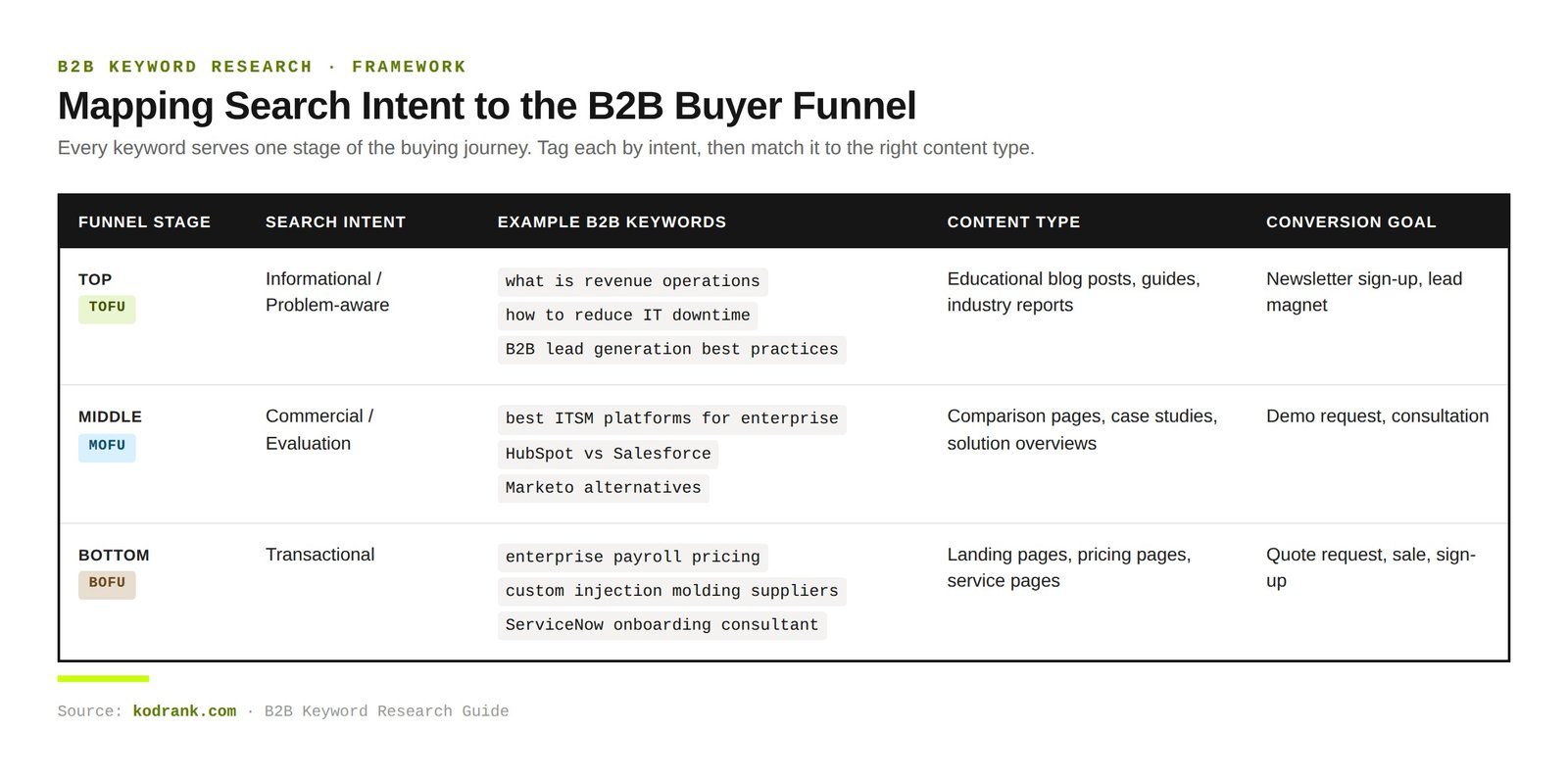
Top-of-funnel (TOFU) terms build awareness and feed lead magnets. Middle-of-funnel (MOFU) terms — especially the "vs," "alternative to," and "best [tool] for [use case]" queries — are where B2B keyword research earns its return, because these searchers are in an active buying cycle. Bottom-of-funnel (BOFU) terms are few but decisive; they belong on pricing, service, and landing pages.
The B2B Keyword Research Process, Step by Step
With intent understood, here is the repeatable process. Treat it as a loop you revisit quarterly, not a one-time project.
Step 1: Define Your Buyer and Their Language
Start with who you are trying to reach. List the roles in your buying committee — the practitioner who feels the pain, the manager who scopes solutions, the executive who signs off. For each, note the problems they own and the words they use. Your best keyword sources are not tools; they are your CRM notes, sales-call transcripts, support tickets, and the questions buyers type into your contact forms. That is where the real vocabulary lives, in your buyers' own words before your team cleaned up the terminology.
Step 2: Build Seed Keywords
Turn each buyer problem into a handful of seed terms — broad phrases tied to your product category and the pain it solves. If you sell scheduling software for clinics, seeds might include appointment scheduling software, reduce patient no-shows, and clinic booking system. Seeds do not need to be perfect; they are the input for expansion in the next step.
Step 3: Choose the Right Keyword Research Tools
Feed your seeds into keyword research tools to generate the full universe of related terms. No single tool does everything, so the smart approach is to combine a few: use free tools to discover and explore, paid tools to validate difficulty, and your own first-party data to find the terms no tool can see. The table below shows which tool to reach for and when.
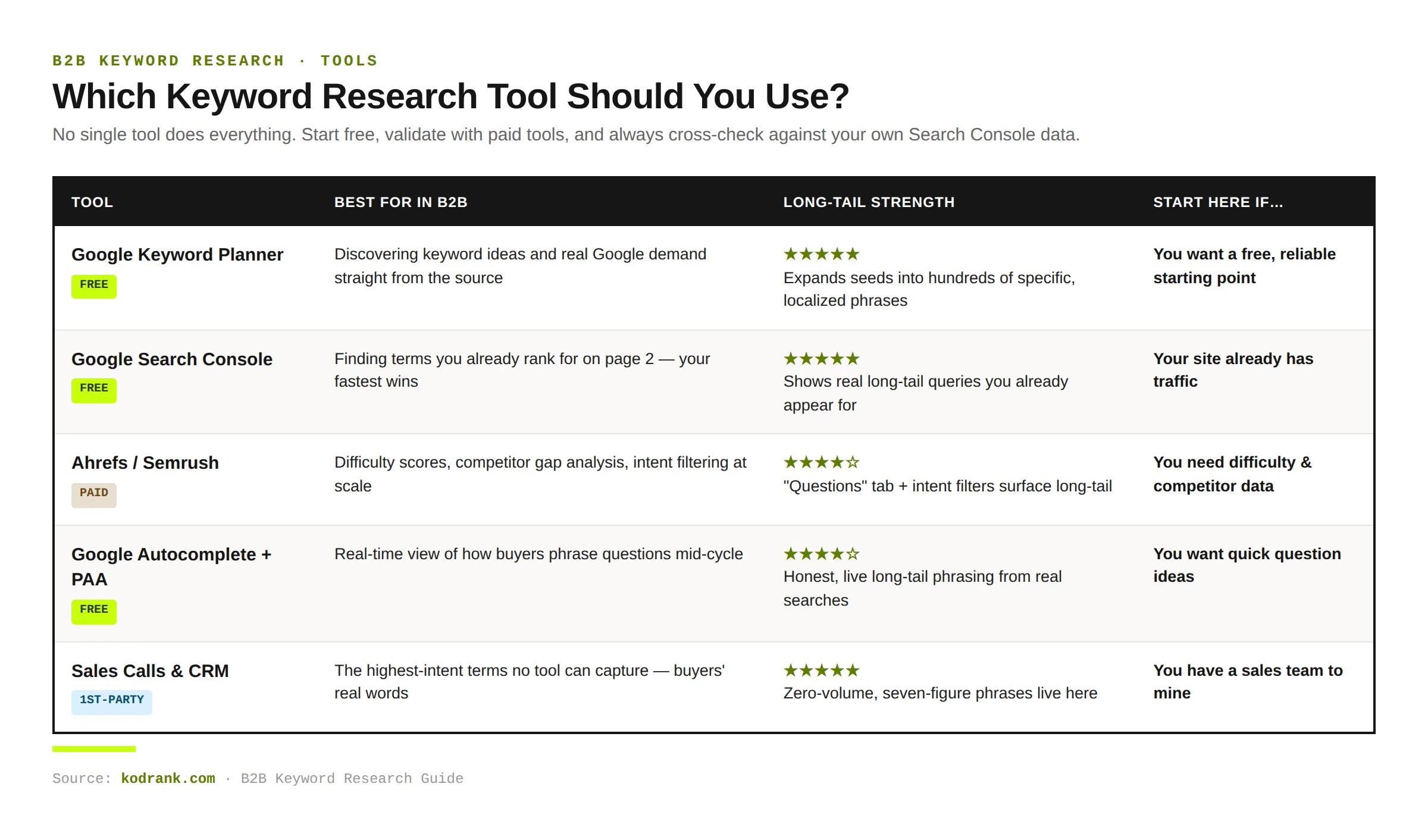
Here is the role each tool plays in a B2B workflow:
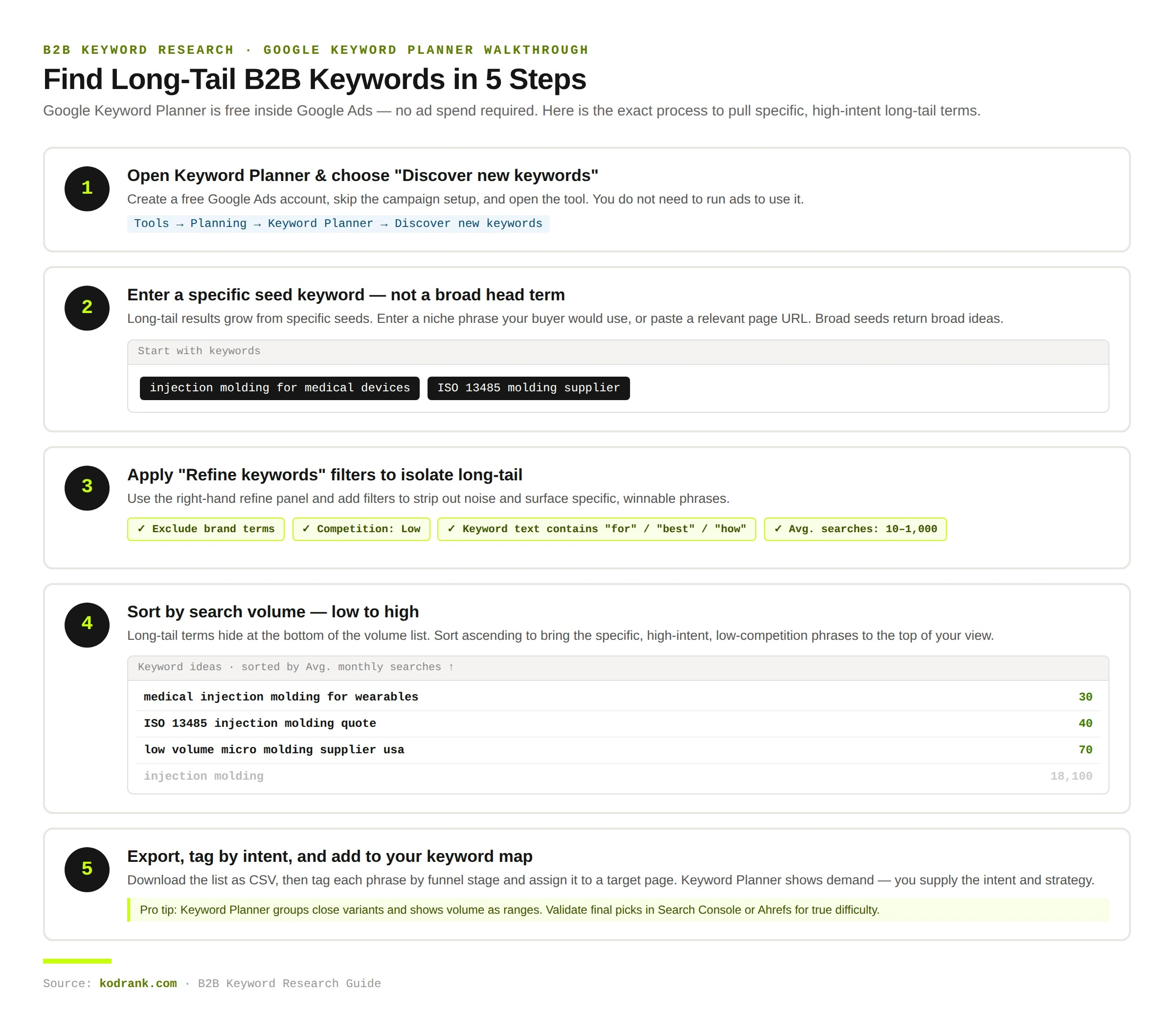
Step 5 — Export, tag by intent, and add to your keyword map. Download the filtered list as a CSV, then tag each phrase by funnel stage and assign it to a target page, exactly as shown in the content-map section below. Keyword Planner tells you what people search and roughly how often; you supply the intent classification and the strategy.
One caveat to keep in mind: Keyword Planner groups close variants together and, without active ad spend, shows volume as broad ranges rather than exact figures. Treat its numbers as a compass, not a map — then validate your final picks in Search Console or a tool like Ahrefs for true ranking difficulty.
Step 4: Find the Zero-Volume and Long-Tail Keywords
This is where B2B keyword research diverges hardest from the consumer playbook. Roughly nine in ten searches are long-tail, and in B2B the highest-intent terms frequently show 10–50 monthly searches — or zero in standard tools. Do not discard them. A phrase that perfectly describes your exact service, searched by the right buyer, can lead to a seven-figure deal. Mine your sales team's discovery calls and RFP language for terms no tool will ever surface.
Step 5: Score and Prioritize by Business Value
You will finish with more keywords than you can act on. Prioritization is what separates a list that collects dust from one that builds pipeline. Stop sorting by search volume. Instead, score each keyword on intent match, commercial proximity (how close the searcher is to buying), and ICP fit — how well the searcher matches your ideal customer. The example below shows how a value score reorders a list so the low-volume, high-intent terms rise to the top where they belong.
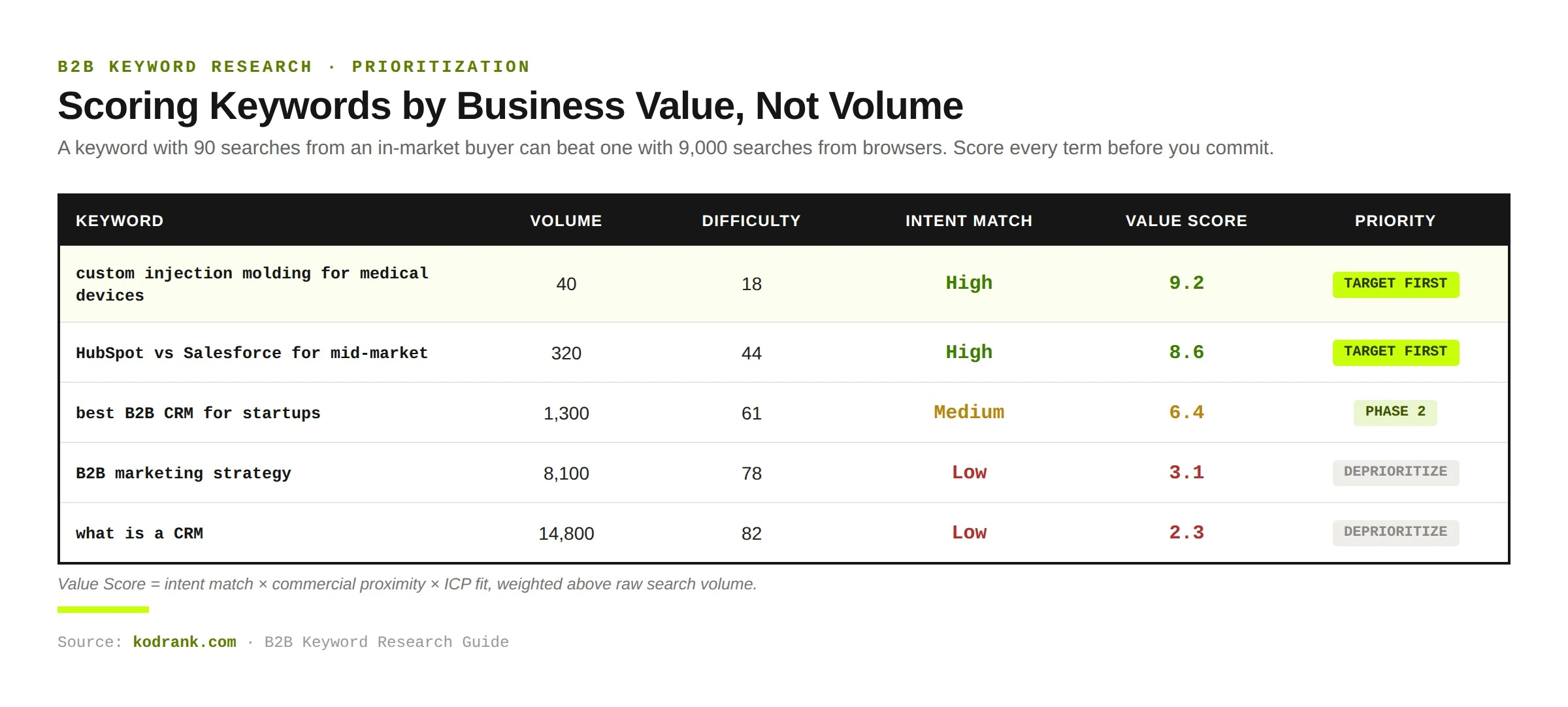
Notice how custom injection molding for medical devices — just 40 searches — outranks what is a CRM at 14,800. Volume is the least important column on the sheet.
Turn Your Keyword List into a Content Map
A keyword list is only valuable once it is activated. The final step of B2B keyword research is assigning every prioritized term to an intent, a funnel stage, a target page, and a content format. Build this as a simple spreadsheet — it becomes the content roadmap that keeps your whole team aligned on what to create and why.
Group your keywords into four to six topical pillars, each with a long-form pillar page targeting the head term, supported by cluster pages that cover related subtopics. Link every cluster page back to its pillar. This hub-and-spoke structure signals topical authority to Google and lifts the whole cluster's rankings — a far stronger strategy than a scatter of unconnected posts. If you are new to structuring clusters.
Optimize for AI Search: AEO and GEO
B2B keyword research in 2026 no longer stops at Google. More than half of searches now end without a click, and a growing share of B2B buyers begin research inside AI tools like ChatGPT, Perplexity, and Google's AI Mode. Being cited in an AI-generated answer can matter more than ranking first on a traditional results page. Two disciplines address this:
• Answer Engine Optimization (AEO) — structuring content so answer engines can extract and cite it. Answer the target query directly in the first two or three sentences of a section, use clear H2 and H3 headings phrased as real questions, and add FAQ schema so machines can parse your page cleanly.
• Generative Engine Optimization (GEO) — earning visibility inside generative AI responses. AI tools pull heavily from authoritative third-party sources, so being present and well-reviewed on platforms like G2, industry review sites, Reddit, and LinkedIn directly influences whether your brand appears in AI recommendations.
The practical takeaway for keyword research: capture the questions your buyers ask, not just the noun phrases. Question-shaped keywords are what AI answer engines match against, which makes them doubly valuable in a zero-click world. For a deeper walkthrough, see our guide to optimizing for AI Overviews.
Common B2B Keyword Research Mistakes to Avoid
Even experienced teams fall into the same traps. Watch for these:
• Chasing volume over intent. High-traffic "what is" terms attract researchers and students, get answered directly by AI Overviews, and rarely convert. Weight intent above volume every time.
• Building one flat list for all buyers. A single list ignores the fact that engineers, finance leads, and operations managers search differently. Segment by role.
• Skipping a funnel stage. If you only target BOFU terms, you have no way to reach buyers earlier; if you only target TOFU, you never convert. Cover the full journey.
• Ignoring low-volume keywords. The terms that convert best in B2B often look too small to bother with. That is exactly why they are uncontested.
• Leaving the list unactivated. Research that never becomes pages, schema, or a content map is just an expensive spreadsheet.
Frequently Asked Questions
What is B2B keyword research?
B2B keyword research is the process of identifying the specific search queries business buyers use when looking for solutions, evaluating vendors, or solving operational problems — then prioritizing the terms most likely to generate qualified leads. Unlike consumer research, it weights buyer intent and business value above raw search volume.
How is B2B keyword research different from B2C?
B2B keyword research targets a buying committee rather than a single shopper, spans a longer research-driven cycle, and centers on specific, often low-volume terms that signal real purchase intent. The same ranking factors apply, but the keywords worth targeting and the buyers behind them are fundamentally different.
What are the best tools for B2B keyword research?
Google Search Console shows the queries you already rank for, Ahrefs and Semrush handle volume, difficulty, and competitor gaps, and Google's own autocomplete and "People Also Ask" surface intent for free. The most valuable B2B keywords, though, come from sales calls and CRM data that no tool can capture.
How often should I redo B2B keyword research?
Review your keyword strategy quarterly for most B2B businesses. Search behavior, competitor positioning, and AI search patterns shift continuously, so a quarterly refresh keeps your content mapped to how buyers actually search — with monthly checks during major product launches or in fast-moving markets.
Should I target low-volume keywords in B2B?
Yes. In B2B, high-intent keywords often show only 10–50 monthly searches, or zero in standard tools, yet they attract the exact decision-makers who control budget. A low-volume term that describes your precise offering usually converts far better than a broad, high-volume one.
Is Google Keyword Planner good for finding long-tail keywords?
Yes, and it is free. Enter a specific seed keyword, apply the "Refine keywords" filters to exclude brand terms and cap volume, then sort by average monthly searches from low to high — the long-tail phrases surface at the top. Keyword Planner shows volume as ranges, so validate difficulty in Search Console or Ahrefs before committing.
Turn Keyword Research into Pipeline
B2B keyword research is not about finding the most-searched terms — it is about finding the right ones: the queries that signal buyer intent, map to a funnel stage, and reach the people who control budget. Understand intent first, build your list from real buyer language, score by business value, and activate every term through a content map built for both search engines and AI answer engines.
Do that consistently and your organic program stops producing traffic reports and starts producing pipeline. Kodrank helps B2B teams build keyword strategies that rank in Google and get cited in AI search — talk to us about your growth goals.