On Page vs Off Page SEO: Key Differences and How They Work Together
Most sites that struggle to rank aren't short on effort. They're short on balance. One business rewrites its service pages for the fifth time while a competitor with thinner content keeps outranking it. Another pays for a batch of backlinks and can't understand why a page that barely answers the question won't move.
Both are getting the on page vs off page SEO question wrong. These aren't rival strategies you pick between. They solve two different problems: on-page SEO makes a page worth ranking, and off-page SEO gives search engines reasons to believe the rest of the web agrees.
This guide explains what each one covers, how they differ, where technical SEO fits, and how to decide what to work on first, with practical examples you can apply to your own site.
On Page vs Off Page SEO: The Short Answer
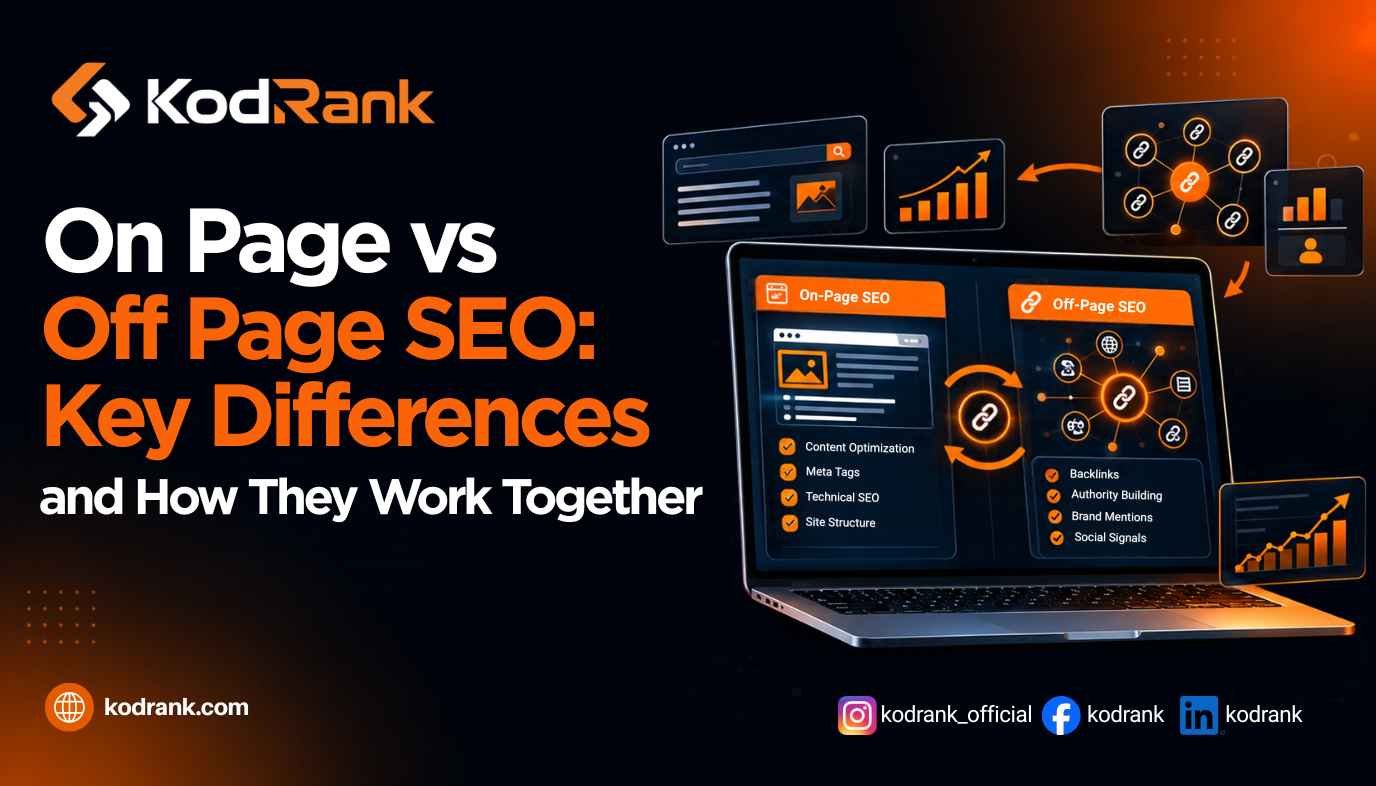
On-page SEO is everything you optimize on your own website, such as content, title tags, headings, internal links, images, and page experience, so search engines understand each page and visitors find it useful. Off-page SEO is everything that happens elsewhere on the web, such as backlinks, brand mentions, reviews, and digital PR, that signals your site is trusted. On-page builds relevance. Off-page builds authority.
You need both. The real question isn't which one to do, but which one is holding your site back right now. The rest of this guide will help you answer that.
What Is On-Page SEO?
On-page SEO is the practice of optimizing the content and HTML of individual pages on your site so search engines understand what each page is about and visitors get what they came for. Every on-page factor sits inside your CMS, which means you can change it today without anyone's permission.
The most important on-page factor isn't a tag at all. Google's own SEO Starter Guide says that compelling, useful content will likely influence your search presence more than anything else it recommends. Tags and structure help search engines read a good page. They can't rescue a weak one.
The core on-page SEO elements
- Search intent and content depth. The page should fully answer the query behind the keyword. Someone searching "on page vs off page SEO" wants a clear comparison, not a sales pitch for an SEO package.
- Keyword targeting. Give each page one primary topic and support it with the related phrases people naturally use. Google says its language systems can connect a page to many queries even without exact-match wording, so natural variety beats repetition. Our guide to B2B keyword research shows how to map terms to pages without overlap.
- Title tags. Write a unique, clear title that accurately describes the page. Google draws on the title element and on-page headings when it generates the clickable headline in search results.
- Meta descriptions. A good description is short, unique, and summarizes the page's key points. Google often builds the snippet from the page content itself, but a well-written description gives you a say in how the result reads.
- Headings. Use H1 to H3 headings to break the page into sections people can scan. Google has said heading order doesn't matter to it, but readers and screen readers rely on a logical structure.
- Internal links and anchor text. Link related pages together with descriptive anchor text. This helps users move through your site and tells search engines what the linked page covers.
- Images and alt text. Use sharp, relevant images placed near related text, and describe each one in its alt attribute.
- Structured data. Schema markup makes pages eligible for rich results such as review stars and carousels, and helps search engines read key details such as prices, ratings, and business information.
Want to see these elements applied to a real page? Our walkthrough of on-page SEO for HVAC rebuilds a single "AC repair" page from a thin services list into one that ranks. If you'd rather hand the work off, KodRank's on-page SEO services cover content, tags, structure and schema in one engagement.
What Is Off-Page SEO?
Off-page SEO covers everything done outside your own website to build its reputation, authority and visibility. You can't edit these signals directly. You earn them by giving other people good reasons to link to you, mention you, review you and recommend you.
Links remain the backbone of off-page work. Google says it finds most new pages through links from pages it has already crawled, and its PageRank algorithm, one of its foundational ranking systems, uses links to judge which pages matter. Google is equally clear that PageRank is only one of many ranking signals. That's why a stack of backlinks can't carry a page that doesn't deserve to rank.
The core off-page SEO elements
- Editorial backlinks. These are links another site chose to give you because your page was worth citing. A single relevant link from a respected industry publication tends to outweigh dozens from unrelated directories.
- Digital PR. Original data, expert commentary, and newsworthy stories pitched to journalists. Done well, it earns links and press coverage at the same time.
- Brand mentions. Your name showing up in articles, podcasts, roundups, and forums, linked or not. Mentions shape how your brand is described across the web, which matters more as people get answers from AI assistants. That's the focus of generative engine optimization.
- Guest contributions. Articles you write for other publications still work when the piece genuinely serves the host site's readers, rather than existing only to carry a link.
- Local citations and reviews. For local businesses, this means a consistent name, address, and phone number across directories, an accurate Google Business Profile, and genuine customer reviews.
- Community and social promotion. Google's starter guide lists social media, community engagement, and word of mouth as ways to help both people and search engines discover your content.
Where off-page SEO goes wrong
Off-page is also where the riskiest shortcuts live, because links are easy to buy. Google's spam policies define link spam as creating links mainly to manipulate rankings, and they name specific practices:
- Buying or selling links that pass ranking credit, including swapping products or services for links
- Excessive "link to me and I'll link to you" exchanges
- Using automated programs or services to build links
- Keyword-rich anchor links in guest posts, articles or press releases distributed across other sites
- Low-quality directory and bookmark links
Sponsored and advertising links aren't banned outright. Google expects them to carry a rel="sponsored" or rel="nofollow" attribute so they don't pass ranking credit. Sites that break these policies may rank lower or disappear from results entirely.
That's why KodRank's off-page SEO services start with a backlink audit and cleanup before any new outreach. If you're comparing providers, our guide on how to choose a good SEO company covers what to ask before you sign.
On-Page vs. Off-Page SEO: Key Differences at a Glance
The biggest difference between on-page and off-page SEO is control. You decide everything on your pages. Off-page signals depend on what other people choose to publish about you.
|
Factor |
On-page SEO |
Off-page SEO |
|---|---|---|
|
Where it happens |
On your own website |
On other websites, platforms and profiles |
|
Main purpose |
Prove relevance and usefulness |
Prove authority and trust |
|
Who controls it |
You, completely |
Other people; you can only influence it |
|
Core activities |
Content, title tags, meta descriptions, headings, internal links, images, schema |
Backlinks, digital PR, brand mentions, guest contributions, citations, reviews |
|
Pace of change |
You can ship a fix today; Google may take weeks to reflect it |
Slower, because it depends on others publishing and on Google recrawling |
|
Biggest risk |
Keyword stuffing, thin or duplicate content |
Link spam, paid links, toxic backlink profiles |
|
What to measure |
Impressions, clicks, CTR and rankings per page in Search Console; conversions |
Referring domains, link relevance, unlinked mentions, branded search growth |
|
Best for |
Pages that get impressions but few clicks, or that rank on page two |
Strong pages stuck behind competitors with more authority |
One practical test: if your page is clearly the best answer on the first page of results and still sits below weaker content, you probably have an authority gap. If your page isn't the best answer, more links won't fix it.
Where Does Technical SEO Fit?
Technical SEO is the third pillar, and it often gets lumped in with on-page work. It covers the site-wide infrastructure that lets search engines crawl, render, and index your pages: site architecture, XML sitemaps, robots.txt, canonical tags, redirects, mobile usability, HTTPS, and page speed.
The easiest way to separate the three is by the question each one answers:
- Technical SEO: Can search engines reach, render, and index this page?
- On-page SEO: Does this page deserve to rank for this search?
- Off-page SEO: Does the rest of the web trust this site?
Page speed sits on the border between technical and on-page. Google measures real-world experience through Core Web Vitals: Largest Contentful Paint for loading (aim for 2.5 seconds or less), Interaction to Next Paint for responsiveness (under 200 milliseconds), and Cumulative Layout Shift for visual stability (under 0.1). Google says good scores align with what its core ranking systems aim to reward.
Technical problems quietly cancel out everything else. A page blocked from indexing won't rank, no matter how good its content or how many sites link to it. That's why a proper audit checks crawlability first. KodRank's technical SEO services handle that foundation, and if you run an online store, our guide to Shopify site speed covers the ecommerce side of performance.
Which Matters More: On-Page or Off-Page SEO?
Neither wins outright, but on-page SEO should almost always come first. It's fully in your control, it's usually cheaper to fix, and it makes every link you earn later worth more. Sending authority to a page that doesn't answer the query is like paying for foot traffic to a store with empty shelves.
Off-page SEO becomes the priority once your pages are genuinely strong and still stuck. That happens a lot in competitive niches, where several sites publish good answers and authority decides the order.
How to decide where to start
- New site or recent redesign: Fix technical and on-page basics first. Make sure pages are indexed, each page targets a distinct topic, and your core pages fully answer the search. Start promoting as soon as you have something worth linking to.
- Pages with plenty of impressions but few clicks: This is an on-page problem. Rewrite title tags and meta descriptions, and check the page actually matches what searchers expect to find.
- Strong pages stuck on page two: This usually points to off-page. Compare your referring domains with the pages ranking above you. If they have far more relevant links, you have an authority gap to close.
- Local businesses: Work both sides at once. Build service and location pages on your site, and keep your Google Business Profile, citations, and reviews healthy off-site.
- Rankings dropped after a link campaign: Audit your backlink profile before doing anything else.
Whatever you change, give it time. Google notes that some changes show up within hours while others take several months, and it suggests waiting a few weeks before judging the impact. If you're working with a tight budget, our guide to SEO services for small businesses covers how to prioritize spend.
How On-Page and Off-Page SEO Work Together
The best results come when on-page and off-page SEO feed each other. Strong pages give other sites a reason to link. Those links bring authority into your site, and smart internal linking moves that authority to the pages that actually generate revenue.
In practice, the loop looks like this:
- Create something worth citing (on-page). Original data, a genuinely useful tool, a detailed guide or an expert take that doesn't exist elsewhere.
- Earn attention for it (off-page). Pitch it to journalists, share it in industry communities, and reach out to sites that already cover the topic.
- Pass the value along (on-page). Link from that resource to your related service or product pages with descriptive anchor text.
- Measure and repeat. Track rankings, referring domains, and conversions, then build the next asset around what worked.
A practical example
Here's an illustrative scenario. A company selling construction project management software has a product page stuck around position 14 for its main keyword. The page has a few decent backlinks, but it's mostly a list of features.
The on-page fix comes first. The team studies the top-ranking pages and notices they all cover pricing, integrations, and real job-site use cases. So they expand the page to answer those questions, rewrite the title tag around the buyer's actual search, add an FAQ section covering buyer objections, and link to the page from four related blog posts.
Then the off-page push. They publish a free, downloadable project schedule template and survey a group of contractors about scheduling delays. The template and survey findings get pitched to construction trade publications and newsletters. As those sites link to the resource, internal links carry that authority to the product page.
Neither half would have worked as well alone. Links pointing to a thin feature list would have been wasted, and a great page with no outside signals would likely have stayed behind more established competitors.
Planning that kind of linkable content takes a clear structure, which is what our guide to building an SEO content strategy walks through. For software companies specifically, KodRank's SaaS SEO services combine both halves, and our monthly SEO services keep the loop running month after month.
Common On-Page and Off-Page SEO Mistakes
Most wasted SEO budgets trace back to a handful of avoidable mistakes:
- Building links to pages that don't deserve them. If a page doesn't fully answer the search, new links rarely hold it at the top. Fix the page first.
- Repeating the keyword until it sounds robotic. Google's spam policies treat keyword stuffing as a violation, and readers notice it immediately. Write naturally and cover the topic thoroughly.
- Chasing a magic word count. Google says content length alone doesn't matter for ranking. Cover what the searcher needs, then stop.
- Still filling in meta keywords. Google Search doesn't use the keywords meta tag, so time spent on it is better spent on titles and content.
- Buying links or repeating exact-match anchors. Paid links that pass ranking credit and keyword-rich anchors in guest posts are both named in Google's link spam policy. A natural profile mixes branded, descriptive, and plain-URL anchors.
- Ignoring internal links. Many sites earn links to their blog and never pass that authority to their service pages. A few well-placed internal links are some of the cheapest wins in SEO.
- Judging results too early. Both on-page and off-page changes take time to register. Give updates a few weeks before deciding they failed.
- Reporting rankings instead of revenue. Positions are a diagnostic. Leads, sales, and sign-ups from organic search are the result. Our post on SEO as performance marketing explains how to connect the two.
Frequently Asked Questions
What is the main difference between on-page and off-page SEO?
On-page SEO covers changes you make on your own website, such as content, title tags, headings, and internal links. Off-page SEO covers signals from outside your site, mainly backlinks, brand mentions, and reviews. On-page tells search engines what a page is about. Off-page tells them how much the web trusts it.
Which is more important, on-page or off-page SEO?
On-page SEO usually comes first because it's fully in your control and makes every future link more valuable. Off-page SEO often decides the order in competitive searches where several pages answer the query well. Most sites need both to hold top positions.
Can a website rank without backlinks?
Yes, particularly for low-competition and long-tail searches. Google can find pages through a submitted sitemap, not only through links. For competitive keywords, though, pages with few meaningful backlinks tend to struggle against established sites.
Are internal links part of on-page or off-page SEO?
Internal links are on-page SEO. They live on your own site, and you control them completely. Backlinks, which point to your site from other domains, are off-page SEO.
Is technical SEO part of on-page SEO?
Technical SEO is usually treated as a separate category, though it overlaps with on-page work. Technical SEO handles site-wide crawling, indexing, speed, and architecture. On-page SEO focuses on the content and HTML of individual pages.
Is social media part of off-page SEO?
Social media is generally grouped with off-page SEO because it happens outside your website. Its main value is visibility: it puts your content in front of people who may later link to it, mention it, or search for your brand. Google's starter guide lists social promotion among the ways to help content get discovered.
Is Google Business Profile on-page or off-page SEO?
Google Business Profile falls under off-page SEO, specifically local SEO, because it lives on Google's platforms rather than your website. Keep its name, address, and phone details consistent with your site and your directory listings.
How long do on-page and off-page SEO take to work?
Google says changes can take anywhere from a few hours to several months to show, and recommends waiting a few weeks before judging impact. On-page changes often register sooner because you control when they go live. Off-page results usually build more slowly as new links are discovered and recrawled.
Do on-page and off-page SEO still matter for AI search?
Yes. Google says standard SEO best practices still apply to AI Overviews and AI Mode, with no special optimizations required. A page must be indexed and eligible to show a snippet before it can appear as a supporting link. To go further, read our guide to optimizing content for AI search engines or explore KodRank's answer engine optimization services.
The Bottom Line
On-page vs. off-page SEO was never a contest. On-page SEO makes your pages the best answer. Off-page SEO proves the rest of the web agrees. Technical SEO makes sure search engines can see both.
Start with the pages you control, then earn the authority to push them higher. If you're not sure which side is holding your site back, request a free audit from KodRank and we'll show you where the gap is.