SEO Performance Marketing: Turn Rankings Into Revenue
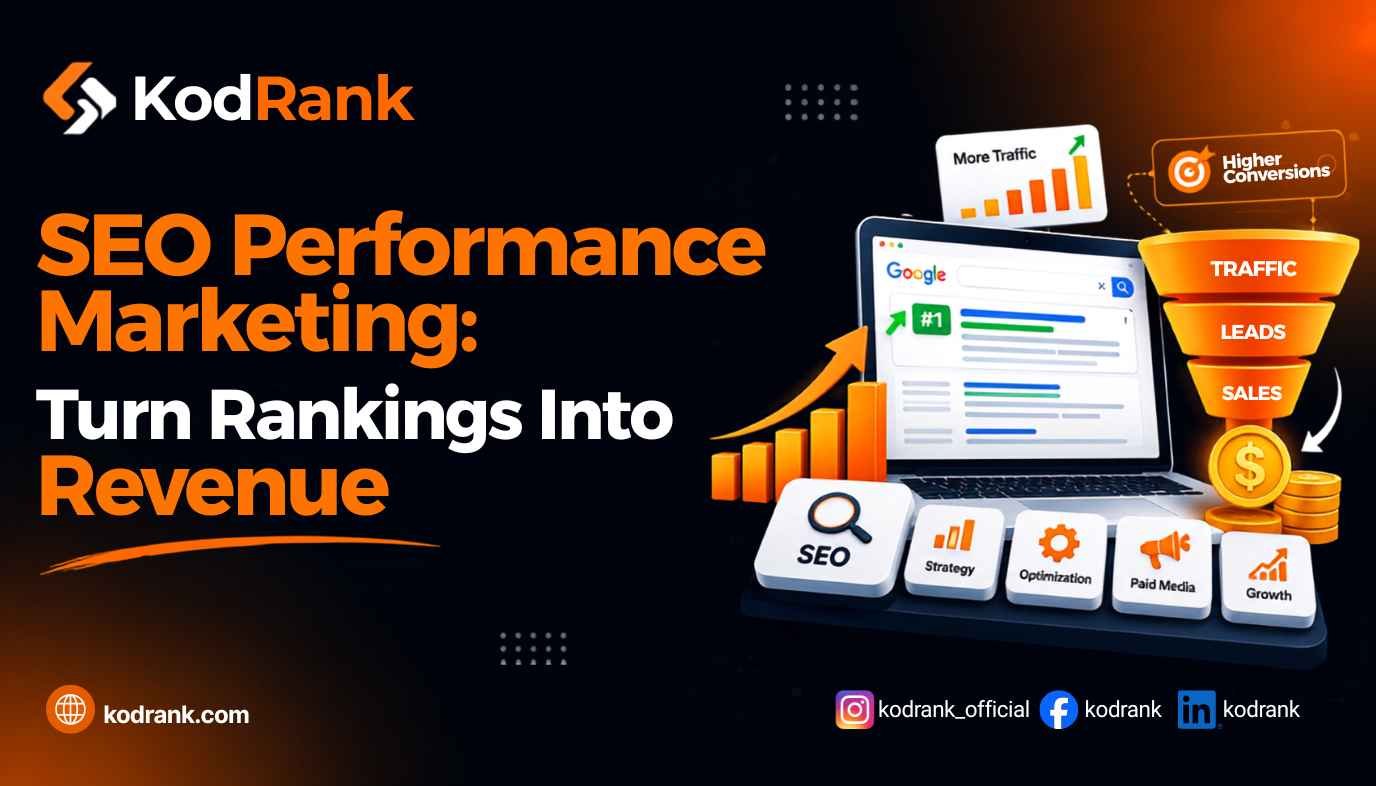
SEO performance marketing is the practice of running SEO like a performance channel — where every keyword, page, and link is measured by the leads, revenue, and pipeline it produces, not just the rankings it earns. It applies the accountability of paid media to organic search, so SEO is judged on business outcomes instead of vanity metrics.
That single shift changes everything about how SEO gets planned, resourced, and reported. Traditional SEO asks, "Did we rank?" SEO performance marketing asks, "Did we make money?" One produces a nice-looking traffic chart. The other produces a number your CFO actually cares about. This guide breaks down what SEO performance marketing is, why it's become the default expectation in 2026, and how to build a program where organic search finally pays for itself.
What Is SEO Performance Marketing?
SEO performance marketing merges two disciplines that used to live in separate teams: the long-term, compounding growth of search engine optimization and the ruthless, ROI-first accountability of performance marketing.
In a traditional setup, SEO reports on rankings, impressions, and sessions — inputs that might lead to revenue. Performance marketing, on the other hand, was built to answer one question: what did each dollar produce? SEO performance marketing takes that performance mindset and points it at organic search. Every target keyword is scored on business value. Every page is tied to a conversion goal. Every backlink is justified by the competitive keyword it helps you win — and the revenue that keyword drives.
Put simply: it's SEO where "we ranked #3" is not an acceptable answer to "did marketing pay for itself this quarter?"
Why SEO Performance Marketing Matters in 2026
Three forces have pushed organic search from a "nice to have" into a channel that has to prove its worth like any other line item.
Budgets are under a microscope. Marketing leaders can no longer defend SEO on faith. The good news is the numbers back it up when you measure properly — organic search generates leads at roughly $31 each versus about $181 for paid search, an efficiency gap that only widens as SEO compounds (First Page Sage). And SEO-sourced leads close at around 14.6%, compared to just 1.7% for outbound (First Page Sage). But those wins only show up in reporting when you're actually tracking them.
Organic is still the largest doorway to your site. Across a broad sample of websites, organic search accounts for roughly 53% of all trackable traffic — more than every paid channel combined (BrightEdge). Leaving that unmeasured means flying blind on your biggest source of demand.
AI search has made "rankings" a shakier proxy than ever. By 2026 data, about 83% of searches that trigger Google's AI Overviews end without a click (Topify.ai). When a #1 ranking no longer guarantees a visit, obsessing over position is even more dangerous. What you can still measure reliably is the revenue that organic search — including AI citations and assisted conversions — actually delivers. That's the whole point of a performance lens.
This is exactly the philosophy behind KodRank's digital marketing services, which are built around one metric — pipeline — rather than a menu of activity reports.
SEO Performance Marketing vs. Traditional SEO
The two aren't opposites; performance marketing is what traditional SEO grows into when a business gets serious about accountability. Here's where they diverge.
- Primary goal. Traditional SEO: rankings and traffic. Performance SEO: qualified leads, revenue, and cost per acquisition.
- How keywords are chosen. Traditional SEO: search volume and difficulty. Performance SEO: buyer intent and business value first, volume second.
- What "success" looks like. Traditional SEO: a traffic line going up. Performance SEO: a revenue-attribution report leadership can act on.
- Reporting cadence. Traditional SEO: a monthly PDF nobody opens. Performance SEO: a five-minute report tied to pipeline, reviewed weekly.
- Attitude to AI search. Traditional SEO: worried about lost clicks. Performance SEO: measures AI visibility and assisted revenue as part of the picture.
A ranking you can't connect to a dollar is a hypothesis. Performance marketing is the discipline of testing it.
The Metrics That Actually Matter
If you only remember one thing from this guide, make it this: stop leading with rankings. Here are the metrics an SEO performance marketing program actually reports on.
1. Organic-Sourced Revenue and Pipeline
The headline number. How much revenue did organic search directly drive, and how much did it assist? A mature setup reports something like: "Organic drove $18K in closed revenue last month and assisted another $52K that converted through other channels." That's a sentence a board understands.
2. Cost Per Acquisition (CPA) and Cost Per Lead (CPL)
Divide your total SEO investment by the leads or customers it produced. This is what lets you compare organic search fairly against paid — and it's usually where SEO wins decisively over time, because the cost per lead falls as content and authority compound while paid CPL stays flat or rises.
3. Conversion Rate by Landing Page
Not every ranking page earns its keep. Segmenting conversion rate by URL tells you which pages to double down on, which to fix, and which are pulling traffic that never converts.
4. Keyword-to-Revenue Mapping
Tie your top converting keywords back to the pages and content that rank for them. This is how you decide where the next content dollar goes — toward terms that close, not terms that trend.
5. AI and Assisted Visibility
Track how often you're cited in AI Overviews, ChatGPT, and Perplexity, plus assisted conversions where organic was the first touch. Turning that raw signal into decisions is the core idea behind search engine marketing intelligence — using real data to decide where every hour and dollar goes.
How to Build an SEO Performance Marketing Program
Here's the sequence KodRank runs when we rebuild SEO around performance rather than activity.
1. Fix attribution before anything else. You can't run a performance channel you can't measure. Set up conversion tracking in GA4, define what counts as a lead, tag organic properly, and build a dashboard that ties organic sessions to conversions and revenue. Without this step, everything after it is guesswork.
2. Re-score your keywords on business value. Take your existing target list and re-rank it — not by volume, but by buyer stage and revenue potential. A 200-search term that closes deals beats a 20,000-search term that never does. For B2B specifically, this is a discipline of its own; our guide to B2B keyword research walks through prioritizing terms your actual buyers use.
3. Audit existing pages for revenue leaks. Before writing anything new, find the pages that rank but don't convert, and the near-miss pages sitting on page two of high-value terms. Most sites can lift results 20–40% just by fixing what they already have.
4. Build the execution layers around intent. Performance shows up when three things work together: on-page SEO that aligns content and structure with intent, off-page SEO that earns the authority to win competitive terms, and technical SEO that makes sure the site is fast and crawlable enough to convert the traffic it earns.
5. Optimize for AI answers, not just blue links. Structure content to be extracted and cited — lead with direct answers, attribute your stats, and use clean headings. KodRank's AEO services and GEO services are built specifically to make sites quotable by answer and generative engines, protecting your visibility even as clicks move to AI surfaces.
6. Report on money, then review weekly. Replace the 40-page monthly PDF with a short report tied to pipeline, and review it weekly. Small performance dips compound fast in search — catching them early is half the advantage. A predictable monthly SEO retainer is how most teams keep this loop running without it falling off the calendar.
How SEO Performance Marketing Works With Paid Search
The smartest teams in 2026 don't pick a side — they run organic and paid as one connected system. Paid search delivers speed and immediate, controllable results; SEO delivers compounding, lower-cost growth that keeps working after the budget is spent. Used together, paid can validate which keywords convert before you invest months of SEO effort into them, and the CPA data from ads becomes a benchmark that proves how much cheaper your organic leads really are.
The mistake is treating them as rival budgets. In an SEO performance marketing model, they share the same scoreboard: leads, CPA, and revenue. Whoever produces those most efficiently gets more of the budget.
Common Mistakes to Avoid
- Still leading with rankings. A ranking report without revenue context tells an incomplete — and often misleading — story.
- No attribution setup. If you can't tie organic to conversions, you can't run it as a performance channel. Full stop.
- Chasing volume over intent. High-traffic keywords that never convert are a cost, not a win.
- Ignoring existing pages. Refreshing decaying, near-miss pages usually beats writing new content from scratch.
- Measuring monthly, acting quarterly. Weekly reviews catch problems while they're still cheap to fix.
- Forgetting AI visibility. If you're not tracking citations and assisted conversions, you're underselling your own performance.
Tools That Support SEO Performance Marketing
- Google Analytics 4 + Google Search Console — the foundation for tying organic traffic to conversions and revenue.
- Semrush or Ahrefs — keyword research, competitor gaps, and rank tracking scored against business value.
- A CRM (HubSpot, Salesforce, Pipedrive) — where organic leads become pipeline you can actually attribute.
- AI-visibility platforms — newer tools that track how you appear in ChatGPT, Perplexity, Gemini, and AI Overviews.
Tools surface the signals. A performance mindset decides what to do with them.
Frequently Asked Questions
What is SEO performance marketing in simple terms?
It's SEO run like a performance channel — where every keyword, page, and link is measured by the leads and revenue it produces, not just the rankings it earns. It brings the ROI accountability of paid media to organic search.
How is SEO performance marketing different from regular SEO?
Regular SEO optimizes for rankings and traffic. SEO performance marketing ties those activities to business outcomes — qualified leads, cost per acquisition, and revenue — and reports on money rather than position.
Can you really measure ROI from SEO?
Yes, once attribution is set up. With proper conversion tracking in GA4 and a CRM, you can report organic-sourced revenue, assisted conversions, and cost per lead. Industry data puts median SEO ROI around 748%, or about $7.48 back for every $1 invested (First Page Sage) — but you only capture that story by measuring it.
Does SEO performance marketing replace PPC?
No — they work best together. PPC delivers fast, controllable results and validates which keywords convert; SEO delivers compounding, lower-cost growth over time. In a performance model, both are judged on the same metrics: leads, CPA, and revenue.
How long before SEO performance marketing shows results?
Technical and on-page fixes can move numbers in 4–8 weeks. Meaningful ranking and revenue growth typically starts around month 3, with compounding pipeline impact around months 5–7. Anyone promising revenue in 30 days is selling ads, not SEO.
The Bottom Line
SEO performance marketing is what organic search looks like when it stops asking to be trusted and starts proving its worth. By fixing attribution, scoring keywords on business value, and reporting on revenue instead of rankings, you turn SEO from a cost center that produces charts into a growth engine that produces pipeline. In a 2026 landscape shaped by rising ad costs and zero-click AI results, the brands pulling ahead aren't the ones with the most traffic — they're the ones who can point to exactly what that traffic earned.
Ready to run SEO like the revenue channel it should be? Talk to KodRank's team and we'll build you a search program measured in pipeline, not position.