What Type of Skills Are Needed for Web Development?
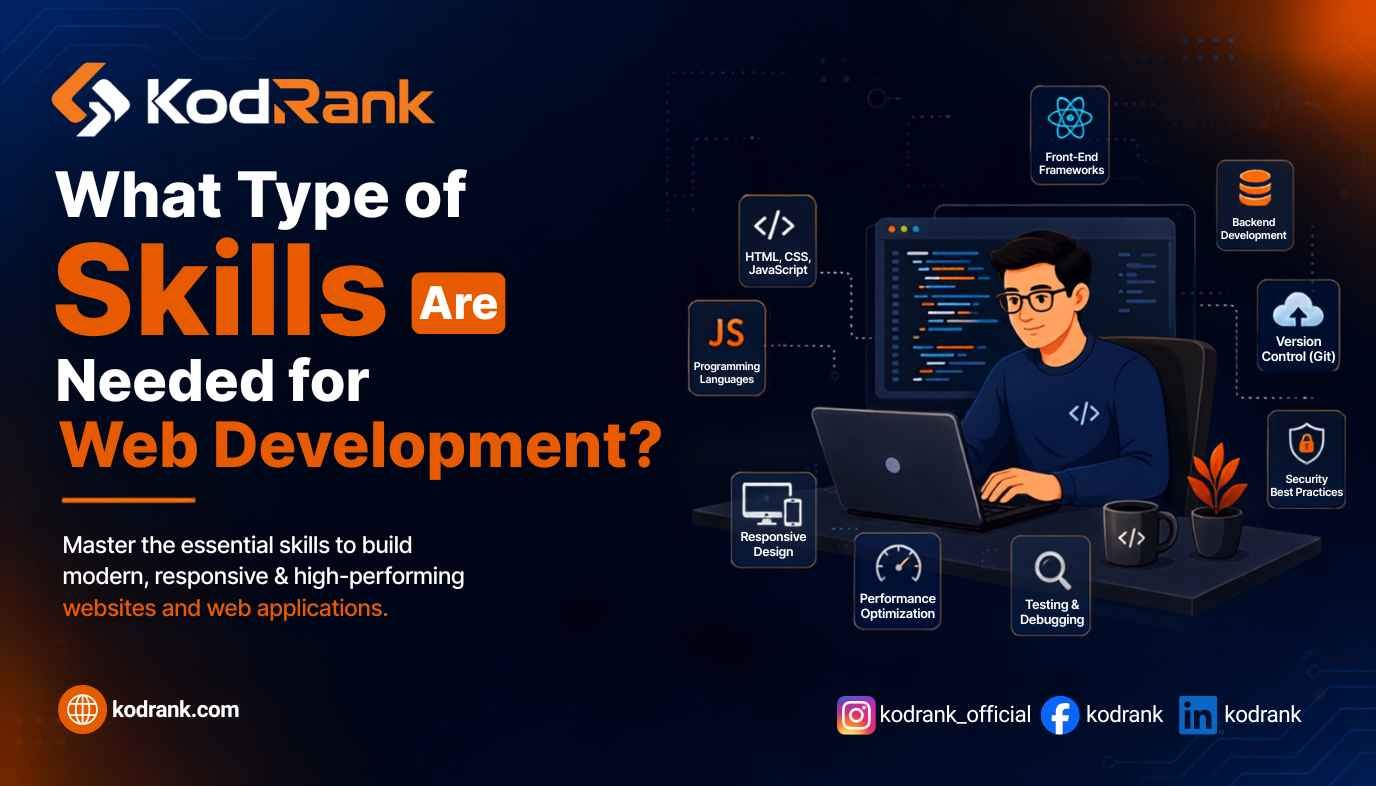
Web development requires a mix of technical and non-technical skills: core languages (HTML, CSS, JavaScript), at least one frontend framework (React, Vue, or Angular), backend and database knowledge (Node.js, Python, SQL), version control with Git, API design, cloud and DevOps basics, security awareness, plus soft skills like problem-solving and communication. In short, a modern web developer needs to write clean code, ship fast websites, and collaborate well with a team.
If you've been wondering what type of skill are needed for web development in 2026, the honest answer is that the list has grown — but it's also more learnable than ever. AI assistants now draft the boilerplate, which has raised the bar for what a professional developer actually needs to understand. This guide breaks down every skill category, from absolute fundamentals to the emerging abilities that separate a standout developer from a code assembler.
The Two Sides of Web Development Skills
Before the checklist, it helps to know how the field splits. Web development skills fall into three buckets:
- Frontend skills — everything the user sees and interacts with in the browser.
- Backend skills — the servers, databases, and logic running behind the scenes.
- Full-stack skills — the ability to work across both, which is highly valued in the industry.
Layered on top of all three are the universal skills — version control, security, and communication — that every developer needs regardless of specialty.
What Type of Skills Are Needed for Web Development: The Core Technical Stack
These are non-negotiable. Every web developer, whatever their specialty, builds on this foundation.
1. HTML and CSS
HTML5 and CSS3 are the backbone of the web. You need semantic HTML for structure and accessibility, and modern CSS — Flexbox, Grid, and custom properties — to build responsive layouts that work on any screen. With the shift toward design systems and utility-first frameworks like Tailwind, a strong grasp of CSS matters more than ever, not less.
2. JavaScript (and TypeScript)
JavaScript is the dominant language of the web, powering both frontend interactivity and, through Node.js, backend logic. In 2026, TypeScript is treated as the baseline rather than an upgrade — its type safety catches bugs early and makes large codebases maintainable. If you learn one language deeply, make it JavaScript, then add TypeScript on top.
3. A Frontend Framework
Frameworks let you build reusable components instead of reinventing the wheel. React remains the most in-demand frontend skill in the job market, with React 19 baking in the React Compiler and Server Components. Vue offers similar power with less complexity, and Angular — backed by Google — suits large enterprise applications. Learning at least one is essential.
4. Backend and Database Skills
The backend handles requests, business logic, and data. Key skills here include:
- Server-side languages: Node.js, Python, PHP, or Java.
- Backend frameworks: Express, Django, Laravel, or FastAPI — FastAPI has become a default for Python APIs where performance and simplicity matter.
- Databases: both SQL (PostgreSQL, MySQL) and NoSQL (MongoDB), plus the ability to model data cleanly.
5. APIs (REST and GraphQL)
Modern applications are API-driven. You need to know how to build, consume, and secure REST endpoints, and increasingly how to work with GraphQL for flexible data fetching. This is the connective tissue between frontend and backend.
Universal Skills Every Developer Needs
These apply no matter which part of the stack you focus on.
Version Control with Git
Git is one of the most essential yet underrated skills. It lets teams track changes, branch and merge safely, and revert when something breaks. No developer works in isolation — in real projects, multiple people share one codebase, and without version control that quickly becomes chaos.
Cloud and DevOps Basics
Cloud and DevOps skills are increasingly expected. Familiarity with a major platform (AWS, Azure, or Google Cloud), plus basic CI/CD pipelines and deployment workflows, turns a coder into someone who can ship production-ready applications.
Web Security
Security is now a core competency, not an afterthought. Understanding common vulnerabilities (XSS, SQL injection, CSRF), authentication, HTTPS, and safe data handling protects both your users and your employer.
Performance and Accessibility
"Speed is a feature" holds true in 2026 — users expect near-instant load times. Alongside performance, accessibility compliance has become a legal requirement in several markets, so building inclusive, standards-compliant interfaces is now part of the job rather than a nice-to-have.
Emerging Skills That Set You Apart
The fundamentals get you hired; these skills get you ahead.
- AI integration: connecting apps to AI models, adding chatbots, and building AI-assisted features is now a mainstream expectation, not a novelty.
- Meta-frameworks: Next.js, Nuxt, SvelteKit, and Astro, plus knowing when to use server-side rendering, static generation, or client-side rendering for a given page.
- CMS and platform expertise: many businesses build on WordPress, Shopify, or headless CMS platforms rather than from scratch, so knowing these ecosystems opens a large share of real-world work.
- SEO and UX awareness: developers who understand how their code affects search visibility and user experience deliver far more value than those who only write features.
Soft Skills Matter More Than You Think
Technical ability gets you in the door; soft skills build a career. The most valuable are problem-solving (debugging is really structured problem-solving), clear communication with designers and non-technical stakeholders, collaboration within a team, time management, and a genuine willingness to keep learning. The stack changes every year — adaptability is the meta-skill that keeps all the others relevant.
How to Start Building These Skills
You don't need every skill on day one. A practical order looks like this:
- Master the fundamentals — HTML, CSS, and JavaScript.
- Add TypeScript and one frontend framework — React is the safest bet for jobs.
- Learn Git early — use it on every project from the start.
- Pick up a backend language and a database — build a full-stack project end to end.
- Layer on cloud, security, and a meta-framework — then specialize toward what you enjoy.
The best way to learn is to build something real, break it, fix it, and understand why it broke.
Frequently Asked Questions
What type of skill are needed for web development? You need technical skills — HTML, CSS, JavaScript, a frontend framework, backend and database knowledge, Git, APIs, cloud basics, and security — plus soft skills like problem-solving, communication, and adaptability.
Do I need to know both frontend and backend? Not to start. You can specialize in frontend or backend and build a strong career. Developers who do both are called full-stack developers and are highly valued, but many roles focus on just one side.
Which programming language should I learn first for web development? JavaScript. It runs on both the frontend and, via Node.js, the backend, so a single language covers the full stack. Add TypeScript once you're comfortable.
How long does it take to learn web development? Most people reach a job-ready level in roughly 6–12 months of consistent practice, depending on prior experience and how much time they invest each week.
Are coding skills enough to get hired? No. Employers also look for version control habits, an understanding of performance and accessibility, and soft skills like communication and collaboration. A portfolio of real projects usually matters more than certificates.
The Bottom Line
So, what type of skills are needed for web development? A blend of solid fundamentals (HTML, CSS, JavaScript), framework fluency, backend and database knowledge, universal skills like Git and security, and human skills like problem-solving and communication. The list evolves every year, but developers who own the fundamentals and stay curious will always be in demand.
If your priority is a great website rather than becoming a developer yourself, the smarter move is often to partner with a specialist team that already has these skills in-house.
Need Web Development Done Right?
Building a modern website takes the full skill set above — and Kodrank's team brings all of it under one roof. Whether you need a custom build, a migration, or a redesign, explore our specialized services:
- WordPress Development Services
- Shopify Development Services
- AI Chatbot Development Services
- Website Redesign Services
- CMS Development Services
Ready to build something exceptional? Skip the hiring and upskilling curve — talk to Kodrank's web development experts and get a fast, secure, high-performing website built by a team that already has every one of these skills covered.