Keyword Research Tools for AEO in LLMs: The Real Stack for 2026
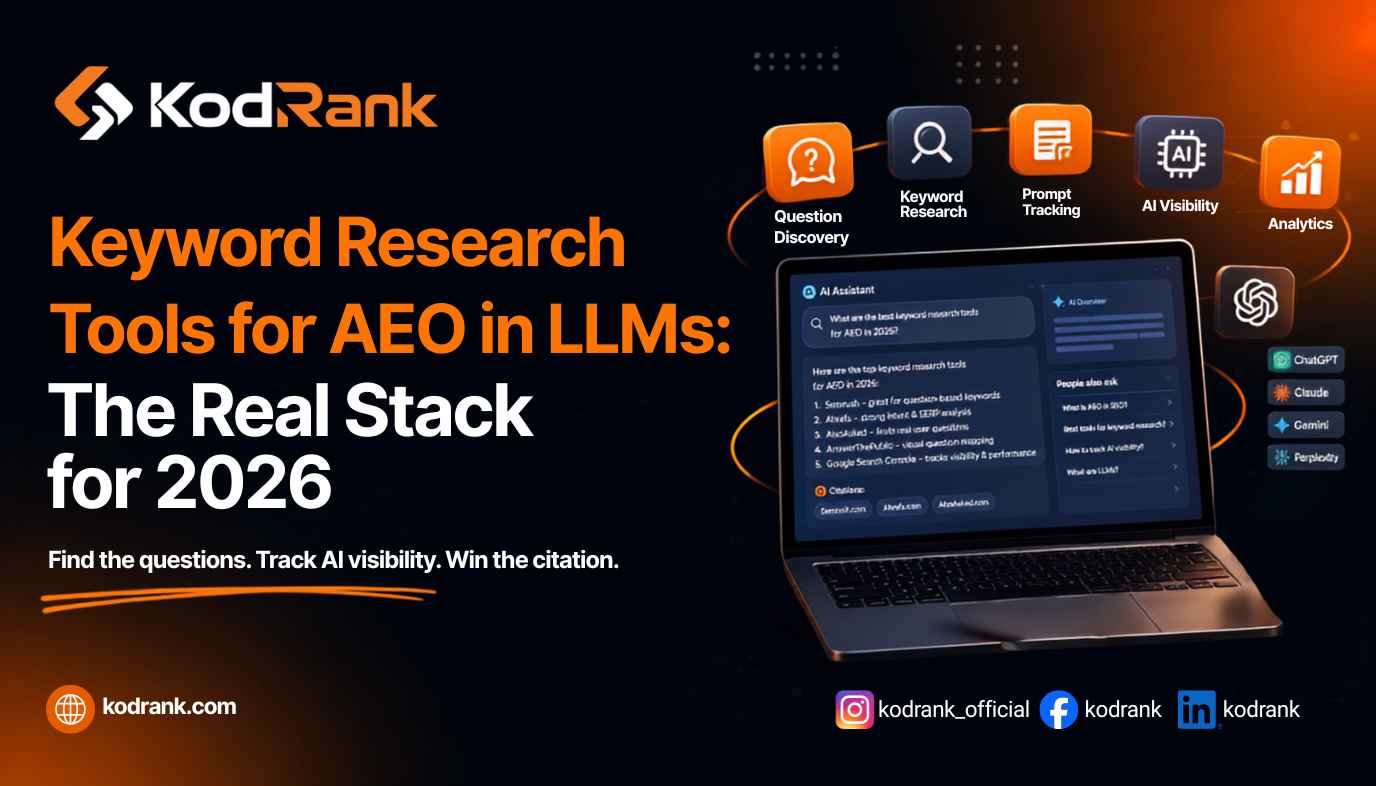
The best keyword research tools for AEO in LLMs aren't the ones that report search volume; they're the ones that surface the conversational questions people actually ask ChatGPT, Perplexity, and Google AI Overviews, and then show you whether an AI engine cites you when someone asks. In practice, that means a small stack: a question-mapping tool like AlsoAsked or AnswerThePublic to find how buyers phrase things, an AI-visibility tracker like LLMrefs, Peec AI, or Otterly to see if you're being named, and Google Search Console to validate real demand on your own pages.
That's the short answer. The longer one is more useful, because the reason your old keyword tool suddenly feels wrong isn't the tool; it's that the unit of search has changed underneath it. This guide walks through what actually shifted, which tools map to which job, and how to build a stack that gets you cited instead of just ranked.
Why Keyword Research Broke When Search Became Conversational
Traditional keyword research was built on one assumption: a person types two or three words, a search engine returns ten links, and your job is to rank in that list. Everything the classic tools measure monthly search volume, keyword difficulty, cost per click exists to serve that model.
AI answer engines don't work that way. When someone asks ChatGPT or Google's AI Mode a question, they type a full sentence, often 15 to 40 words long, loaded with context: their role, their constraints, their situation. The engine doesn't return a list for them to sift through. It reads the web, extracts what it trusts, and synthesizes a single answer, usually citing a handful of sources. There's often no click at all. By industry estimates from SparkToro and Similarweb, more than 60% of searches now end without one.
So the metrics that defined keyword research quietly stopped predicting anything. There is no "monthly search volume" for a question typed into ChatGPT; no public number exists. Ranking #1 on Google no longer guarantees you appear in the AI answer above it; Moz's 2026 analysis of nearly 40,000 queries found that 88% of Google AI Mode citations come from outside the organic top 10. The question you need to answer has changed from "what keywords have volume?" to "what questions do my buyers ask AI, and does the AI name me when they do?"
This is the shift that separates real keyword research tools for AEO in LLMs from SEO tools wearing an "AI" badge. If you want the fuller picture of how this changes content itself, we broke it down in how to optimize content for AI search engines — this piece focuses on the research layer that feeds it.
The One Concept That Explains Everything: Query Fan-Out
Before you pick a tool, it helps to understand the mechanism that makes AEO keyword research different — because once you see it, the tool categories organize themselves.
When you ask Google's AI Mode a question, it doesn't run one search. It runs many. Google calls this query fan-out. At Google I/O 2025, Head of Search Elizabeth Reid described it plainly: AI Mode breaks your question into subtopics and issues a multitude of queries simultaneously on your behalf, using a custom version of Gemini 2.5 to do it. A single user prompt commonly fans out into eight to twelve parallel sub-queries: comparisons, specifications, pricing, "how-to" steps, related entities, each retrieved separately, then synthesized into one answer.
Here's why that matters for research. Your page can be a perfect match for the prompt a user typed and still be invisible to the sub-queries that actually decide which sources get cited. ChatGPT, Perplexity, and Copilot use their own versions of this decomposition. So AEO keyword research isn't about targeting the question; it's about covering the cluster of hidden sub-questions a single question triggers.
That reframes the whole exercise:
| Keyword research (SEO) | Keyword/prompt research (AEO in LLMs) | |
|---|---|---|
| Unit | Short keyword, 1–4 words | Full conversational question, 15–40+ words |
| Goal | Rank in the list of links | Get cited inside the answer |
| Primary signal | Search volume, difficulty | Question coverage, citation likelihood |
| What you map | A ranked list of terms | A tree of questions and their sub-questions |
| Success metric | Position and clicks | Share of voice across AI engines |
Keep that table in mind as you read the tool categories below — each category exists to solve one row of it.
The Three Categories of Keyword Research Tools for AEO in LLMs
There's no single tool that does all of this well, and any vendor claiming otherwise is overselling. A working stack draws from three distinct jobs. Pick one tool per job, and you've covered the whole workflow.
1. Question & Prompt Discovery: Finding How People Actually Ask
This is where AEO keyword research begins, and it's the closest cousin to traditional research. Instead of chasing head terms, you're building a structured map of the questions real people ask about your category, in their own conversational language.
AlsoAsked crawls Google's "People Also Ask" chains and visualizes them as branching question trees. It's built for exactly the sub-question logic that query fan-out rewards: you enter a topic and see how one question leads to the next, which maps neatly onto how you should structure a page. Its paid plans start around $15/month, with a free tier for a few searches a day.
AnswerThePublic aggregates autocomplete data from Google, YouTube, and other platforms into a full landscape of who/what/how/why/when/where phrasings. It's strong for capturing the raw, natural-language way people talk, which is what AI engines are trained to answer. Individual plans start around $10/month, again with a limited free tier.
Semrush's Keyword Magic Tool with the Questions filter, and its newer prompt-research features, extend a traditional platform toward AEO by isolating question-format queries and, in the AI toolkit, surfacing the kinds of prompts users submit to AI systems. If your team already lives in Semrush, this keeps discovery in one place, though the AI-specific tracking is a paid add-on (the core suite starts around $139.95/month, with AI features layered on top).
The practical move here isn't to run one of these and stop. It's to pull question clusters from AlsoAsked, enrich them with the conversational phrasings from AnswerThePublic, and end up with a map of questions organized by intent awareness, comparison, and decision that mirrors how a buyer actually moves toward choosing you.
2. AI Visibility & Prompt Tracking — Seeing Whether You're Cited
This category didn't exist a few years ago, and it's the half of AEO research that traditional SEO tools simply can't do. Discovery tells you what to target; visibility tracking tells you whether it's working whether ChatGPT, Perplexity, Gemini, and AI Overviews actually name your brand when someone asks your priority questions.
LLMrefs is the most SEO-native option, which is exactly why teams that already think in keywords tend to start here. You feed it keywords, and it expands each into a set of prompts across 10+ engines: AI Overviews, AI Mode, Gemini, ChatGPT, Perplexity, Claude, Copilot, Grok, and more, then reports share of voice, rank, and citations. Its auto-generated prompts feature is a genuine differentiator, and it bundles practical AEO utilities like a crawlability checker, an llms.txt generator, and a Reddit-thread finder. Pricing is refreshingly simple: a free plan limited to one keyword, and an all-in-one Pro plan at $79/month covering roughly 500 monthly prompts, unlimited projects and seats, geo-targeting, and API access. The main tradeoff is that it's keyword-first rather than prompt-first, and reporting cadence is lighter than enterprise suites.
Peec AI leans into competitive benchmarking across ChatGPT, Perplexity, Gemini, and others, with multi-market monitoring for teams that need to compare visibility across regions and competitors. It starts around $95/month.
Otterly.AI is the budget-friendly, lean-team entry point for first-time tracking, monitoring brand mentions and citations across ChatGPT, Perplexity, Gemini, Copilot, and AI Mode, with plans starting around $29/month.
Profound sits at the enterprise end, offering deep insight into how brands are framed within LLM responses, with the reporting depth larger organizations need; its self-serve tier starts around $99/month and scales up considerably from there.
The rule of thumb: don't buy an enterprise platform to answer a question a $79 tracker can answer. Start with the smallest tool that covers your priority prompts and the engines your audience actually uses, and only scale up when manual work becomes a genuine time drain. We go deeper on the measurement side: citation share, prompt coverage, sentiment, and tying it all to revenue in how to measure the success of generative engine optimization campaigns.
3. First-Party Validation — Grounding It All in Real Demand
The cheapest and most honest tool in the stack is one you already have. Google Search Console gives you first-party data no third-party tool can: the actual queries your pages appear for, including long, conversational ones with impressions but thin coverage. In 2026, Google added reporting views for visibility within its generative AI features, so you can start to separate AI-surface performance from standard results.
The classic AEO play here is simple: filter for queries with high impressions and low clicks. That gap is your opportunity list: questions where you're showing up but not winning the answer, which is exactly where answer-first content and clean schema can move you into the citation. It's free, it's real, and it keeps your keyword research grounded in demand you can actually prove rather than prompts you merely hope people ask.
How to Build a Working AEO Keyword Research Stack
You don't need all of these. A lean, effective stack looks like this:
- Discover the questions with AlsoAsked (for the question tree) plus AnswerThePublic (for conversational phrasing). Export a clustered list organized by intent, not by volume.
- Validate demand against Google Search Console: which of those questions do your pages already brush up against? Those are your fastest wins.
- Track a focused set of 5–10 priority prompts in an AI-visibility tool like LLMrefs or Otterly, benchmarked against two or three competitors, on a weekly or biweekly cadence.
- Act by rebuilding your highest-opportunity pages answer-first, a direct 40–60 word answer under each question heading, supported by named statistics and clean FAQ schema, then watch citation share move.
Notice that the tools are only half of it. The discipline of narrowing your prompt set, benchmarking competitors, and re-testing on a fixed cadence matters more than which logo you pay for. The teams that win AEO aren't the ones with the most expensive platform; they're the ones who research questions the way their buyers ask them and then structure content a machine can lift cleanly.
Common Mistakes When Choosing AEO Keyword Tools
- Buying a tracker before doing discovery. Visibility tools tell you if you're cited; they don't tell you which questions to target. Do the question research first.
- Chasing volume that doesn't exist. There's no reliable search volume for AI prompts. Prioritize by intent and how winnable the answer is, not by a number a tool can't actually know.
- Tracking too many prompts at once. Start with 5–10 priority questions so the signal stays clean. Trying to track everything buries what matters.
- Ignoring the sub-questions. Because of query fan-out, a page that only answers the headline question misses the cluster that decides citation. Map the branches.
- Over-investing early. A $29–$79 tool answers most teams' questions. Save the enterprise suite for when manual tracking genuinely costs you hours every week.
Frequently Asked Questions
What are keyword research tools for AEO in LLMs?
They're tools that help you find the conversational, question-based queries people ask AI engines like ChatGPT, Perplexity, and Google AI Overviews, and track whether those engines cite your brand. Unlike SEO tools focused on search volume and rankings, AEO tools focus on question coverage, prompt patterns, and citation likelihood. A typical stack combines a question-discovery tool (AlsoAsked, AnswerThePublic), an AI-visibility tracker (LLMrefs, Peec AI, Otterly), and Google Search Console for first-party validation.
How is AEO keyword research different from SEO keyword research?
SEO keyword research targets short keywords and optimizes for ranking in a list of links, measured by volume and clicks. AEO keyword research targets long, conversational questions and optimizes for being cited inside a synthesized AI answer, measured by citation share and question coverage. The core reason is query fan-out: AI engines break one question into many sub-queries, so you research clusters of questions rather than single terms.
Are there free keyword research tools for AEO in LLMs?
Yes. Google Search Console is free and shows real conversational queries your pages appear for, including within AI features. AlsoAsked and AnswerThePublic both offer free tiers for question research, and LLMrefs has a free plan limited to one keyword. This free stack handles a large share of what a paid setup does, especially early on.
Which AI-visibility tool should I start with?
Start with the least expensive tool that covers the engines your audience actually uses and lets you track a focused set of priority prompts. LLMrefs ($79/month) suits SEO-native teams that think in keywords; Otterly.AI (from around $29/month) suits lean teams and first-time tracking; Peec AI (from around $95/month) suits competitive and multi-market benchmarking. Scale up to enterprise platforms only when manual tracking becomes a real-time cost.
Do I still need traditional keyword tools for AEO?
Yes, but you use them differently. Tools like Semrush and Google's own data still matter for isolating question-format queries, understanding intent, and grounding research in real demand. They form the foundation; AEO-specific discovery and visibility tools build the answer-and-citation layer on top of it.
The Bottom Line
The right keyword research tools for AEO in LLMs aren't a single purchase; they're a small, deliberate stack that mirrors how AI search actually works. Discover the real questions people ask, validate them against first-party demand, track whether AI engines cite you, and rebuild your pages to be the answer. The mechanics underneath conversational queries, query fan-out, and citation over ranking are why your old volume-based tool feels off, and why the fix is a change in method more than a software change.
Get the research right, and the rest of AEO follows: you stop guessing which questions matter and start showing up in the answers your buyers actually see.
Winning AI visibility is a discipline, not a one-time fix. Explore KodRank's AEO services to own the direct answers in featured snippets and AI Overviews, and our GEO services to get your brand recommended inside AI-generated answers. Talk to our team and let's build your AI search visibility together.